With degrees and professional training programs across public and international affairs and the social sciences—and course offerings in Syracuse, N.Y., Washington, D.C., and partner locations around the world—Maxwell has something for everyone who wants to make a positive impact in their community.
Make a plan to visit us or connect online.

Prospective Student Visits
Prospective undergraduate first-year and transfer students who have not yet applied to Syracuse University have a range of options for in-person and virtual visits, sample classes, admission interviews and more.
In addition to virtual events, prospective graduate students should contact the admission team for your program to schedule an in-person visit or to attend a class.
Can’t get to campus?
Our virtual tour is the next best thing. Immerse yourself in a 360-degree view of campus as you take a tour led by Syracuse University alumni. Or, register to attend a virtual admission event.

Connect with an Alumni Ambassador
Learn about the Maxwell School from the people who know it best! Alumni Ambassadors are passionate champions of the Maxwell School who are using their Maxwell education to make real and lasting change in the world. Alumni from every degree program working in a range of organizations and industries are available to answer your questions. Connect with one today.
Public Events at Maxwell
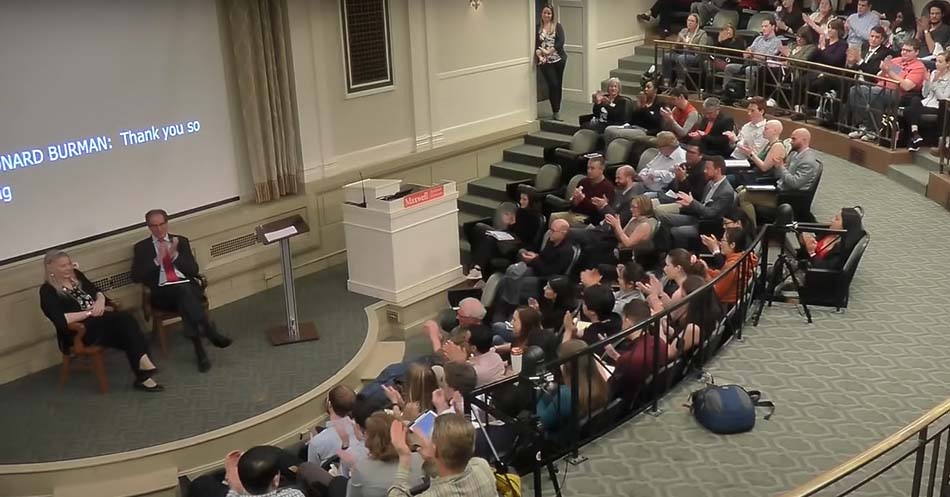
Attend a public event, in person or virtually, and get a taste of what Maxwell School has to offer. With hundreds events each year—including prominent public speakers, lectures, workshops, foreign language conversation tables, research presentations and more—there are so many ways to engage in the intellectual and social life on campus.
Institutions, In Time: Designing Feedback Pathways for Shared Infrastructure Transitions
Virtual
Add to: Outlook, ICal, Google Calendar
Matt Grimley (University of Minnesota) will present at the Institutional Grammar Research Initiative's (IGRI) Research Seminar Series.
Abstract:
Electric utilities, challenged by a rapidly unfolding energy transition, use many informal institutions to bridge across technologies and sectors. Little is known, however, about how electric utility systems and other polycentric systems’ institutions-in-use vary and evolve over time.
This presentation breaks down a novel engaged research method, the Nominal Group Technique, to solicit current, future and potential institutions-in-use from 66 staff and board members across 18 electric utilities in a shared electric system in Minnesota.
Matthew Grimley explores favored institutions for distributed energy resources like solar, electric vehicles, and batteries. Generating 578 ideas in total, his research uses the Institutional Grammar to create institutional statements and identify institutional configurations for current and desired feedback pathways across different infrastructures and actor groups.
The results demonstrate the potential importance of structure and context-related adjustment mechanisms in designing change for shared infrastructure systems and the potential importance of information and payoff rules. Grimley seeks to advance understanding of change theories in polycentric governance systems, toward linear, parallel, recursive, and conjunctive dynamics that expand beyond evolutionary change theories.
His findings show that engaged research methods can help converse between theory and practice, particularly in institutionally and technologically complex systems in periods of transition.
Category
Social Science and Public Policy
Type
Virtual
Region
Virtual
Open to
Organizer
Center for Policy Design and Governance
Accessibility
Contact Erica Ivins to request accommodations