Liz Arnold Named Cramer Family Professor of Practice in Community Impact
October 13, 2025
As part of the Maxwell School’s CCE Office, Arnold is teaching courses to develop the next generation of civic leaders through applied learning and real-world engagement.
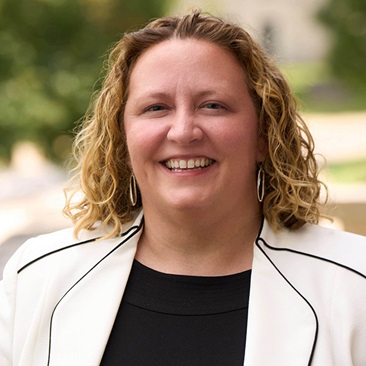
The Maxwell School’s recently appointed Cramer Family Professor of Practice in Community Impact brings a rare combination of community-based civic engagement and expertise in cultivating changemakers across a range of fields.
Liz Arnold joined Maxwell in August as part of the newly formed Civic and Community Engagement (CCE) Office. She is teaching undergraduates from a range of Syracuse University degree programs with a focus on experiential learning, leadership development and problem-solving.
This semester, Arnold is teaching a capstone course in which students are tasked with turning their social science research into an action plan in partnership with a local government or community organization. One project focuses on using social media strategies to help nonprofits expand engagement and impact. Another aims to help families facing hardship to keep their pets while relieving pressure on local shelters.
Arnold plans to develop additional courses focusing on public narrative and civic leadership as well as applied social innovation and partnership building.
“These classes provide students with the analytical tools and practical skills needed to identify social problems, develop evidence-based responses and lead effective community engagement efforts through hands-on research and real-world partnerships,” she says. “By connecting rigorous analysis with practical implementation, students develop the civic leadership skills essential for creating lasting change and strengthening democratic institutions.”
The Cramer Family Professor of Practice in Community Impact was established through a generous gift by the Gerald and Daphna Cramer Foundation to provide support to students across a range of community engagement efforts that develop capabilities and skills in entrepreneurship, civic engagement, philanthropy, systems change, social innovation and impact.
The late Gerald B. Cramer earned a degree in accounting from the Martin J. Whitman School of Management in 1952 and went on to become one of the Maxwell School’s most generous and dedicated supporters. He and his wife, Daphna, funded professorships and graduate assistantships and supported the creation of the Global Affairs Institute at Maxwell (now the Daniel Patrick Moynihan Institute of Global Affairs) as well as the University’s Institute for National Security and Counterterrorism (now the Institute for Security Policy and Law).
Arnold says her work across fields and sectors has given her a unique lens and ability to connect with and mentor students with wide-ranging interests.
Most recently, she served as director of leadership engagement and impact at the Truman National Security Project, where she developed training programs and oversaw national policy and impact networks. At Google, she led national Ph.D. outreach strategies and helped launch diversity initiatives that continue to shape the company’s talent pipeline.
“I'm consistently impressed by how talented and thoughtful my students are—they are genuinely committed to making a difference in their communities. What I hope to teach them is that when you pair natural curiosity and commitment with strong analytical skills and hands-on experience, you can evolve into the type of leader that creates lasting change.”
Liz Arnold
Cramer Family Professor of Practice in Community Impact
Her approach at Maxwell also draws on two decades of experience at top academic institutions. At Cornell University’s Johnson School of Management, she redesigned the technology career curriculum, advised MBA students and grew the school’s High Tech Club into its largest professional organization. At MIT’s School of Engineering, she managed the Undergraduate Practice Opportunities Program, helping engineering students integrate professional skills with technical expertise. And, at the Harvard Kennedy School’s Center for Public Leadership, she coordinated interdisciplinary fellowship programs that immersed graduate students in dialogue with influential leaders.
Across roles, Arnold says she has focused on three core principles: applied learning that connects classroom theory with real-world practice, cross-sector relationship-building, and leadership development that empowers diverse voices. “Whether I was working with engineering students at Google, MBA candidates at Cornell or community members, the approach has been the same—give people the tools, connections and confidence to create change,” she says.
Already, Arnold is building connections with organizations in Syracuse, Rochester and Utica to expand experiential learning opportunities for students. She recently met nonprofit representatives at a volunteer recruitment fair organized by CCE students. She is also collaborating with CCE Director Amy Schmidt ’14 M.P.A. to create new pathways.
“We are thrilled to welcome Liz to the Maxwell School, and we have already seen how her background in higher education, leadership development and innovation is inspiring students,” says Schmidt. “I can't wait to see how her teaching evolves over the coming semesters, and how her expertise leads to exciting new community partnerships."
Dean David M. Van Slyke adds that Arnold’s record of partnership building offers Maxwell students both global perspective and local practice. “She embodies the ideals of engaged citizenship on which the Maxwell School was founded 100 years ago,” he says.
Arnold's commitment to civic life is deeply rooted. Her mother served on a school board, her father was a town justice and several other relatives have been involved in local government, churches and arts organizations.
“Watching my family serve our community taught me that democracy isn't just about voting,” she says. “It's about showing up, doing the work and building relationships.”
Arnold has carried that tradition forward as a trustee for the village of Homer, New York, president of the Zonta Club of Cortland, a gubernatorial appointee to the SUNY Cortland College Council, and in her work to help her hometown secure a $10 million New York State Downtown Revitalization Initiative grant. She also founded Digital Orchards, a career coaching and advisory firm.
Arnold received an MBA from the Université de Genève, a master’s degree in higher education administration from the University of Arizona, and a bachelor’s degree in religion from Princeton University.
“I'm consistently impressed by how talented and thoughtful my students are— they are genuinely committed to making a difference in their communities,” says Arnold. “What I hope to teach them is that when you pair natural curiosity and commitment with strong analytical skills and hands-on experience, you can evolve into the type of leader that creates lasting change. I see my role as helping them learn that effective community engagement requires both heart and rigor to create meaningful impact.”
By Jessica Youngman
Published in the Fall 2025 issue of the Maxwell Perspective
Related News
School News

Oct 1, 2026
School News

Sep 18, 2026
School News
Sep 2, 2026
School News
Aug 31, 2026