New Endowed Scholarship Supports Maxwell Undergraduates
October 17, 2025
It was created with a generous gift by Maxwell School alumnus H. Lewis “Lew” Rapaport and his wife, Whitman alumna Susan Rapaport.
As the founder of the highly successful construction services firm Component Assembly Systems (CAS), Lew Rapaport’s life’s work can be seen throughout some of this country’s most iconic structures: Yankee Stadium, Carnegie Hall and the Freedom Tower at One World Trade Center, to name just a few.
But the most important legacy we have, he says, is the way that we treat others.
“Nobody blooms alone,” says Rapaport of his achievements as the chairman and CEO of CAS. “If you get there,” he adds, “you didn't do it on your own—there were a lot of people behind you.”
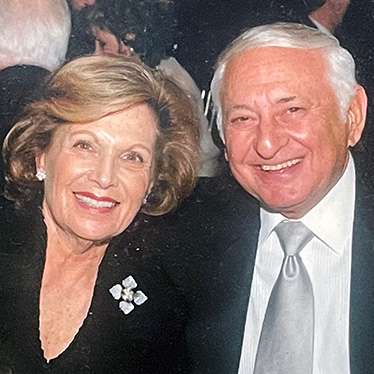
Rapaport, who received a bachelor’s degree in American studies from Maxwell in 1959, credits a “huge amount of folks” with helping him to get where he is today, including the professionals at CAS, as well as his wife, Susan, a 1959 graduate of the Whitman School of Management who also went on to have a successful career.
He also credits the lessons he learned as an undergraduate at Maxwell. To help others just starting out and to show their gratitude to Maxwell and celebrate its recent 100th anniversary, Lew and Susan Rapaport have established the Maxwell Endowed Undergraduate Scholarship fund.
“This generous gift by Lew and Susan demonstrates their enduring commitment to supporting Maxwell and Syracuse University in a most meaningful way—by reducing the financial burden on undergraduates, enabling them to focus on their academics and related learning opportunities,” says Dean David M. Van Slyke. “We are grateful to the Rapaports for their longstanding friendship and generosity to Maxwell, not only because of the benefit to our students, but also because their gift may inspire generosity among others.”
The $100,000 gift marks the Rapaports’ second endowed scholarship at Maxwell; in 2018 they established the Susan and H. Lewis Rapaport Endowed Scholarship to benefit undergraduate students studying history or political science.
Modest Beginnings
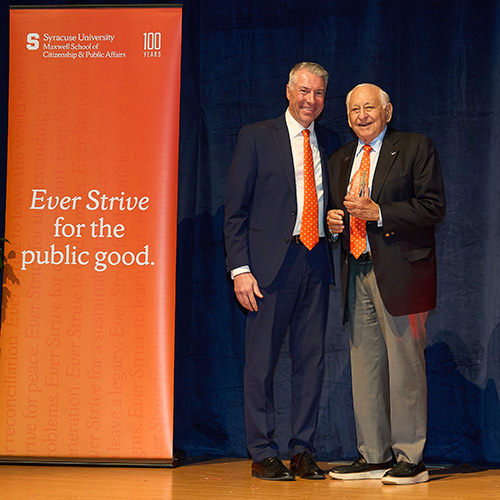
Growing up in Queens, Lew Rapaport’s work ethic and business sense were shaped by his grandfather, a hardworking plumber and business owner on the Lower East Side of Manhattan, and his father, an architect who also owned his own firm. However, the young Rapaport’s main interests were not construction; they were American history and military history. “I read just about every book my high school library and the local library had on the Civil War,” he recalls.
Rapaport came to Syracuse in 1955 as a young ROTC candidate during the Korean War. He began taking classes in history and economics, eventually declaring a major in American studies. “The professors I had, some of them were world famous,” he says. “Stuart Gerry Brown was one of the foremost experts in the United States on Ralph Waldo Emerson.”
He credits the school with helping to broaden his perspective, to see the world from multiple viewpoints, and to understand how democracy works.
Another Maxwell professor, Władysław Kulski, served in the Polish foreign ministry before World War II and helped to negotiate the Anglo-Polish military alliance. “He used to read to us every day from Pravda, telling us what they were saying from the Russian point of view, and then read from the New York Times—and there were two different stories,” recalls Rapaport. “I realized right away…you needed world information, and you needed information from people who were there and lived it, like Dr. Kulski.”
He also learned how to disagree respectfully while staying true to his values—an especially important lesson for today’s undergraduates, he says.
Rapaport recalls an incident on campus in which an anti-war protest group tried to disrupt ROTC marching drills. “I said to myself when it was all over, and I would say this today to young people: Stand up for what you think is right. You may not agree with my side, and I may not agree with your side. But you must try to negotiate.”
Meanwhile, Rapaport’s fiancé, Susan, transferred to Syracuse University from Skidmore College and earned a business degree from Whitman.
“This generous gift by Lew and Susan demonstrates their enduring commitment to supporting Maxwell and Syracuse University in a most meaningful way—by reducing the financial burden on undergraduates, enabling them to focus on their academics and related learning opportunities.”
Dean David M. Van Slyke
Helping Hands
By the time Lew and Susan graduated from Syracuse University in 1959, the Korean War had ended. The two married before Lew went into the Army and graduated from the U.S. Army Artillery and Missile School at Fort Sill, later serving as a training officer at Fort Dix. After completing his service, he took a job as a construction supervisor for the Webb & Knapp Co. in New York City, which built the Lincoln Towers.
Soon, in 1964, he and a co-worker started a small business of their own, called Score Carpentry—the precursor to CAS. Their first project was the Gas Pavilion Building at the New York World’s Fair. Over the next six decades, Rapaport would grow it into a national company with eight locations in major cities throughout the U.S.
A longtime Maxwell School Advisory Board member, Rapaport is a Life Trustee of the USS Constitution Museum in Boston and a member of the Patriots Circle of the World War II Museum in New Orleans. In 2024, the Maxwell School awarded Rapaport the Centennial Changemaker Award in Economic Development.
Key to his success, Rapaport says, has been his enduring credo: “Never give up,” he says, adding, “and always do unto others as you would have done unto you.”
By Jessica Smith
Published in the Fall 2025 issue of the Maxwell Perspective
Related News
School News
Sep 24, 2026
School News
Sep 10, 2026
School News
Sep 9, 2026
School News
Sep 2, 2026