MPA Alumnus Is Changing Lives, One Home at a Time
By Jessica Youngman
August 26, 2026
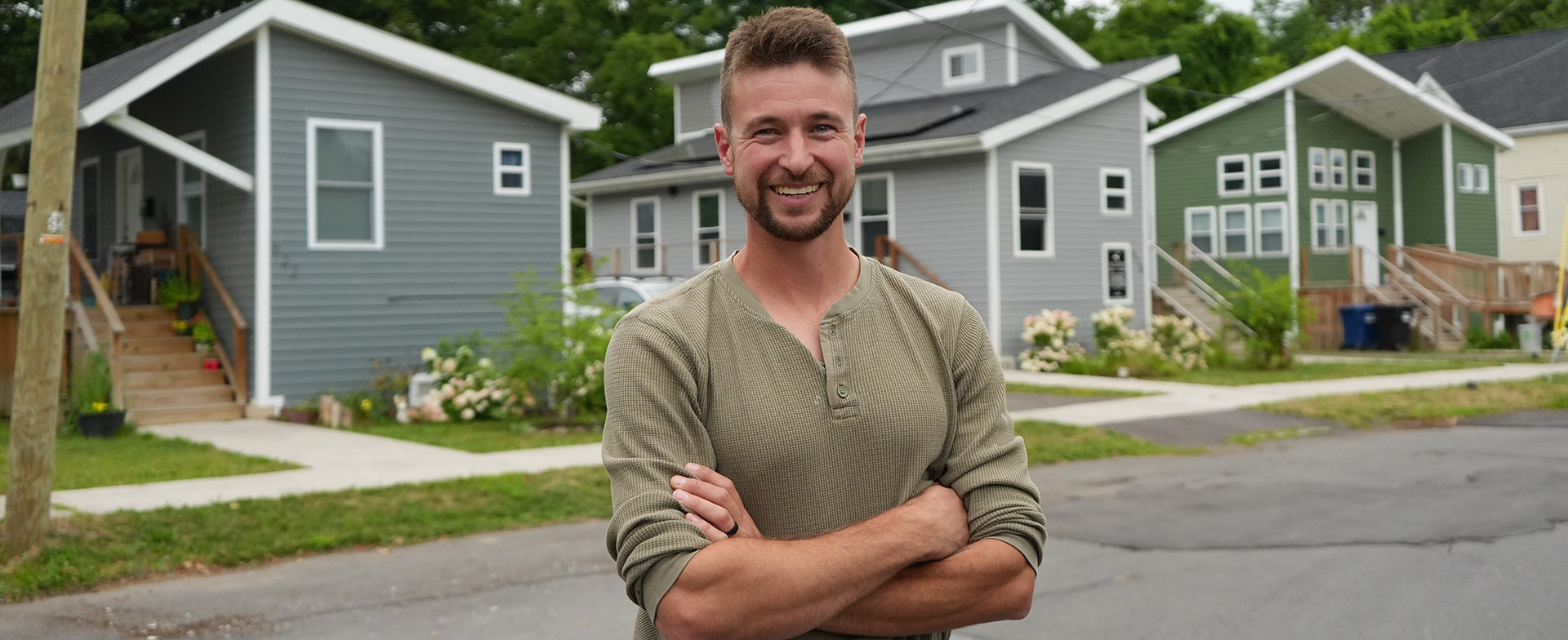
Andrew Lunetta found his focus at the Maxwell School—now he’s a ‘CNN Hero’ building homes for people who need them most.
At the edge of a park on Syracuse’s Rich Street, a small dog barks with excitement, straining to get closer to roughly 30 approaching walkers. Jill Ceilly holds the other end of the leash.
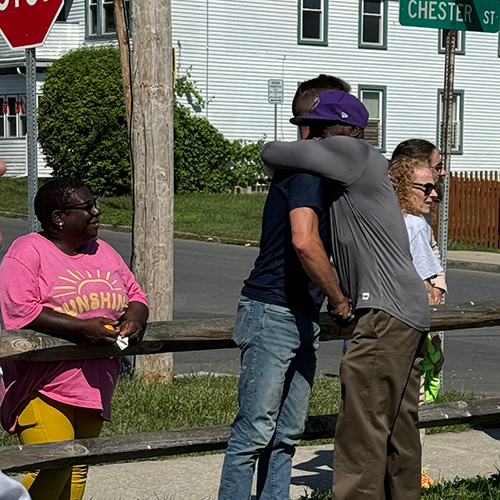
Maxwell School alumnus Andrew Lunetta is among the walkers. “Hey, Jack,” says Lunetta to the dog, before it leaps into his welcoming arms.
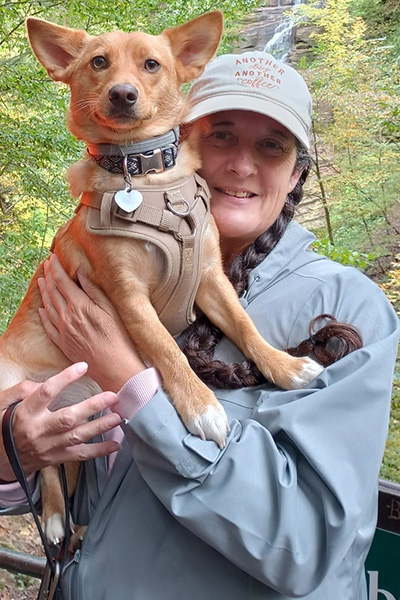
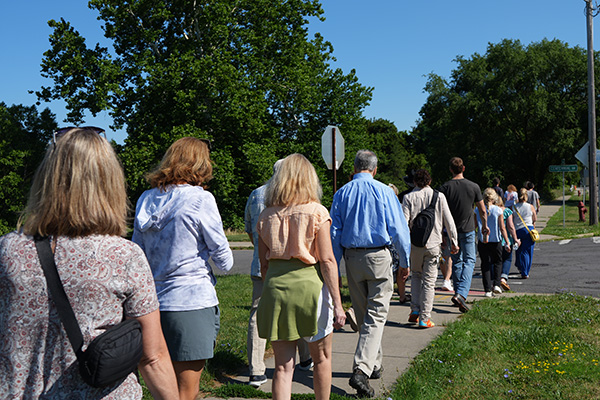
Ceilly and Jack live across the street from the park in a home built by Lunetta’s nonprofit, A Tiny Home for Good. This scene plays out nearly every Tuesday morning: Tiny Home staff and supporters embark on a 2-mile walk that starts at the organization’s headquarters on South Avenue and passes several of the homes it has built or rehabbed.
Along the way, several tenants, including Ceilly, join the walk or step outside for a friendly catch-up. The route is filled with conversation, laughter and hugs—a contrast to the hard times many tenants have known, from job loss and addiction to domestic abuse and illness.
What’s clear: They count Lunetta a friend, and perhaps a lifesaver.
“When he says he’s going to do something, it gets done,” Ceilly says. “He’s not just a landlord. He’s trying to build a community.”
Lunetta founded A Tiny Home for Good in 2014, the same year he earned a master of public administration from Maxwell. In the 12 years since, the nonprofit has built 23 tiny homes and rehabilitated nearly two dozen additional properties across Syracuse, housing 47 people, with roughly two dozen more projects underway.
That work made Lunetta a 2026 CNN Hero, an honor given annually to people making extraordinary contributions to their communities. The segment aired in July, featuring some of the tenants on the walk this recent Tuesday morning.
When the call came in late 2025, Lunetta didn’t believe it. “I thought it was just a scam—a call from some random number saying someone from CNN was trying to reach me,” he says. A committee had already reviewed a nomination on his behalf, and after months of vetting, made it official.
Lunetta says the recognition isn’t about him. “It’s a recognition of what our team has built,” he says.
A Different Plan
Lunetta didn’t come to Maxwell with homelessness on his mind. He arrived planning to work with international organizations in a career that would involve extensive travel.
“I don’t remember the professor, but I remember the class. I remember exactly where I was sitting,” Lunetta says. “I remember thinking, ‘Oh—this is not what I want to do.’”
Lunetta volunteered at a 115-bed men’s shelter in Syracuse during his undergraduate years at LeMoyne College and eventually became a staff member. He watched a cycle that never seemed to break. Men would leave with a plan to find stable housing and, time and again, come back, often because they couldn’t afford anything beyond some of the city’s worst housing stock.
“Maybe a quarter of the way through that first year, I really started asking myself: What do I care about?” Lunetta says. “And it was this. It was the work at the shelter, hearing the guys’ stories, trying to find a solution.”
He focused on nonprofit management. The idea for what would become A Tiny Home for Good—permanent, dignified housing paired with long-term support—began to take shape.
Lunetta said his Maxwell coursework gave him tools he reaches for every day. Chief among them: statistics, taught by Sarah Hamersma, associate professor of public administration and international affairs.
“Statistics was something I would have run in the opposite direction from,” says Lunetta. “She’d come in and share a statistic that’s published, that everyone treats as gospel, and then break down why it didn’t actually hold up. It was like, ‘Wow—these numbers I’ve always been afraid of are actually useful.’”
Hamersma says Lunetta “was that ideal student we always dream of for the M.P.A.” She added, “He had a vision for serving the public good—a big vision—and he was ready to work really hard to master the skills he needed, even the ones that didn’t come naturally.”
Lunetta said Tina Nabatchi’s course in public organizations and management gave frameworks for running an organization.
“I went into Maxwell thinking I’d do something very different,” he says. “There’s a very direct line from what I learned there to where I ended up. Without it, I probably would have ended up doing something I wasn’t best suited for.”
One House at a Time
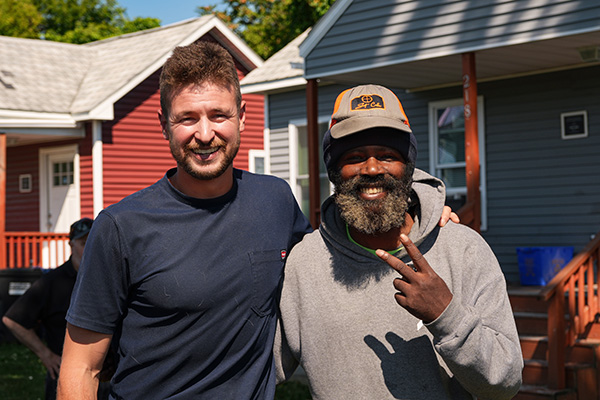
While pursuing his M.P.A. and volunteering in the shelter, Lunetta talked about his idea for A Tiny Home for Good with nearly everyone in the community supporting the unhoused. People told him the idea could work but cautioned him about the capital and risk involved. He started the paperwork while still a student.
“For a while, from 2016 to 2020, pretty much, it was just me,” he says. The operation looks different today: volunteer crews, tradespeople and sponsoring businesses now handle much of the physical construction. Lunetta still finds his way onto job sites. “I really love that part of the work,” he says. “I hope to always spend at least a little bit of time doing it.”
One of the most recent projects sits right next door to the headquarters: a two-family home that just cleared final approval for occupancy after a remodel. Out back, a new playground sits near a pergola designed and built by Syracuse University architecture students.
Every home the organization builds or renovates goes to someone who would not pass a typical background check for market-rate housing. Most go to tenants pulled from the county’s coordinated entry list, which ranks people by how long they’ve experienced homelessness; those with co-occurring substance use or mental health needs rank near the top.
“We’re proud of that,” Lunetta says. “That’s who our houses are for.”
Back on the recent Tuesday walk, Tiny Homes tenant Rhea Holmes strikes up easy conversation with friends and newcomers. Earlier, she introduced herself to visitors from Syracuse University and the Greater Syracuse Association of Realtors as “a hugger,” and several took her up on the invitation.
Weeks earlier, Holmes’ story had featured prominently in Lunetta’s CNN Hero segment: after her husband of 26 years died, grief cost her everything, and she spent eight months sleeping at his grave in Oakwood Cemetery.
I went into Maxwell thinking I’d do something very different. There’s a very direct line from what I learned there to where I ended up. Without it, I probably would have ended up doing something I wasn’t best suited for.”
Andrew Lunetta ’14 M.P.A.
founder of A Tiny Home for Good and a 2026 CNN Hero
What Comes Next
Lunetta expects the CNN Hero recognition to bring more attention and potentially a few more donors, but he doesn’t expect much else to change. “Our model has been really successful for 10 years,” he says. “It might just give us more resources to do that better.”
Dean David M. Van Slyke says Lunetta’s commitment as a social entrepreneur to the kind of impact that benefits the public good is “exactly what the Maxwell School stands for— leaving what we find better than we found it.”
“It’s a privilege to have alumni like Andrew working to improve the communities they’re part of,” he adds.
Asked what he’d tell a prospective student weighing an M.P.A., Lunetta pointed to his own experience. He believed he needed a fixed career plan when he embarked on his graduate studies and realized it was quite the opposite.
His other advice is about staying connected beyond the classroom. He remembers classmates who treated their time at Maxwell like a nine-to-five job, disconnected from the city around them. “Getting connected outside the Maxwell-SU bubble is really important,” he says.
‘My Everything’
One of the final stops on the walk is a tiny home to tenant Dolphus Johnson.
In 2016, at 41, he became the first person to move into a tiny home built by Lunetta’s newly established nonprofit. Johnson hadn’t had a permanent address since he was 13, and his first few years weren’t easy: he was managing undiagnosed schizophrenia and a substance use disorder. With consistent support from case managers, he settled into a routine.
Today, Johnson works as a janitor for the organization.
“I don’t know if I’d still be doing this work if it weren’t for him,” Lunetta says. “He really is the lifeblood behind our work.”
A large portrait of Johnson hangs in A Tiny Home for Good headquarters as a constant reminder. Lunetta keeps a note on his desk with a question that serves as a compass—it says, “Is this right for Dolphus?”
“I knew Dolphus before I started A Tiny Home for Good, when I worked at the shelter, and I imagined what a tiny home neighborhood serving him would look like,” says Lunetta.
Of Lunetta, Johnson says, “He’s my everything.”
INTERVIEW EXTRA
Andrew Lunetta ’14 M.P.A. recently sat down with the Maxwell School communications and media relations team to talk about his CNN Hero honor, what inspires his work and the advice he’d provide to students. Check it out below.
Related News
School News

Oct 27, 2026
Media Coverage
Oct 27, 2026
Research
Oct 26, 2026
School News
Oct 20, 2026