What Is America? Maxwell Scholars Take On the Nation’s 250th
By Jessica Youngman
November 16, 2026
Through a conference, 13 public lectures, a poll and more, the Maxwell school has spent a year examining how well the U.S. has lived up to its founding principles.
Pollster and Maxwell School alumnus John Zogby has spent four decades researching public opinion on everything from presidential races to how people in Arab and Muslim countries view the United States. The results have been reported near and far, from The New York Times to Al Jazeera.
One question, though, has eluded his data: “What is America?”
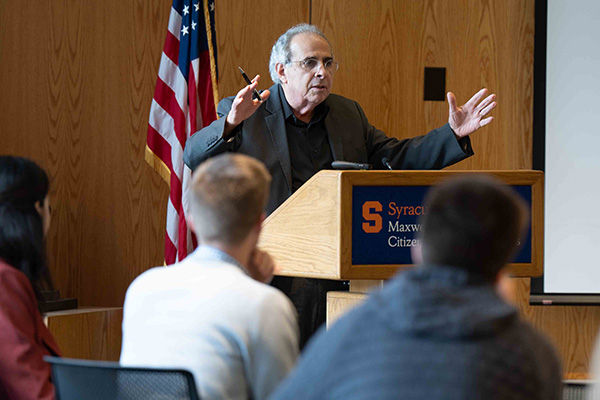
On a Friday afternoon in October, Zogby returned to Maxwell, where he received a master’s degree in history in 1974, and put the question to a room of faculty, students and parents in town for Family Weekend. He told them it has been asked and answered many times over the past 250 years, “yet we can’t seem to get a grip.”
The trouble, as Zogby sees it, is that Americans share the words but not the meaning. His polling has found that people who prize the same ideals, such as freedom, opportunity and fair elections, divide sharply over what they mean and who gets to enjoy them. Part of the problem, he said, is the gap between the idea of America, which “speaks to the aspirations of people,” and the reality of the United States, a nation made up of many groups with their own interests.
Zogby’s talk was part of “Agents of Change: Leadership, Scholarship and the American Experience at 250,” a daylong conference that brought together scholars of history, politics, economics, sociology, public administration, law and public health.
It was the centerpiece of a year of USA@250 programs that also included 13 free public lectures by Maxwell scholars, an alumni gathering in Philadelphia, a traveling exhibit on public service in the Maxwell foyer, and a poll asking Maxwell community members what the country means to them.
Dean David M. Van Slyke said the year’s effort is “grounded in a single central question: How has the United States lived up to its founding principles of equality, life, liberty and the pursuit of happiness?”
What Does America Mean to You?
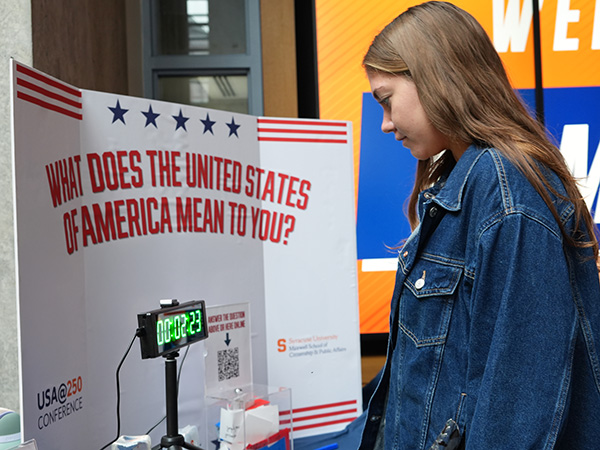
A booth set up in Maxwell’s Strasser Commons and a virtual poll asked students, faculty and staff a variation of Zogby’s question in the Fall 2026 semester: “What does the United States of America mean to you?”
The poll wasn’t scientific, and dozens of answers speak only for the people who gave them. Still, they echoed what Zogby described: a country that people hold in very different ways. Some expressed optimism, pride and aspiration, including one respondent who called the U.S. “a shining city on a hill” and another who called it “a place where anyone can come for a better life.”
Others wrote about being shut out. A few were angry. One entry read, “In my opinion the United States, in the year 2026, represents bigotry, authoritarian backsliding, nationalism, imperialism and much more…”
Still another respondent was pragmatic: “As we celebrate 250 years of independence, I think it is important to reflect not only on how far we have come, but also on how much progress we still have the potential to make.”
Why people answer so differently is the kind of puzzle Maxwell scholars take on. Shana Kushner Gadarian, professor of political science and associate dean for faculty and research, studies political identity and polarization—a topic woven through her two books, Anxious Politics: Democratic Citizenship in a Threatening World (Cambridge University Press, 2015) and the co-authored Pandemic Politics: The Deadly Toll of Partisanship in the Age of COVID (Princeton University Press, 2022).
Gadarian delved into the topic in her USA@250 lecture last spring. She acknowledged the country’s current climate and reminded participants about another time in history that saw an even greater divide: the Civil War.
What’s more, Gadarian said, Americans often compare today’s polarization to the relatively unified 1950s and ’60s. In that era, the parties themselves were more ideologically diverse within, she explained, with conservative southern Democrats and northeastern Rockefeller Republicans feeling a sense of belonging in their respective parties.
“That came at a cost of having two parties that maybe were very similar to each other,” said Gadarian in the lecture, which was recorded and is now available on Maxwell’s YouTube channel along with several others taught by faculty colleagues. “And we now have more choices, but the parties are farther apart.”
At the October Agents of Change conference, her Maxwell political science colleague, Chris Faricy, director of the Campbell Public Affairs Institute, echoed the perspective. In the 1950s, he said, “You could be at a dinner party, tell someone you’re a Republican, and that doesn’t mean you’re a conservative.”
Faricy traced the transfer of power from committee chairs to party leaders in Congress in the 1970s as one cause of the change. “Today, when you ask who the most powerful people in Congress are, it’s the Senate majority leader and the Speaker of the House, which is indicative of this change,” he said.
A Contest Over Who Belongs
The Maxwell School was founded in 1924 during a time of national unrest. The U.S. was turning inward, with World War I still a recent memory. Congress extended citizenship to Native Americans born in the United States and passed a law sharply restricting immigration through national-origins quotas. In a 12-month period, the nation both widened and narrowed its definition of who belongs.
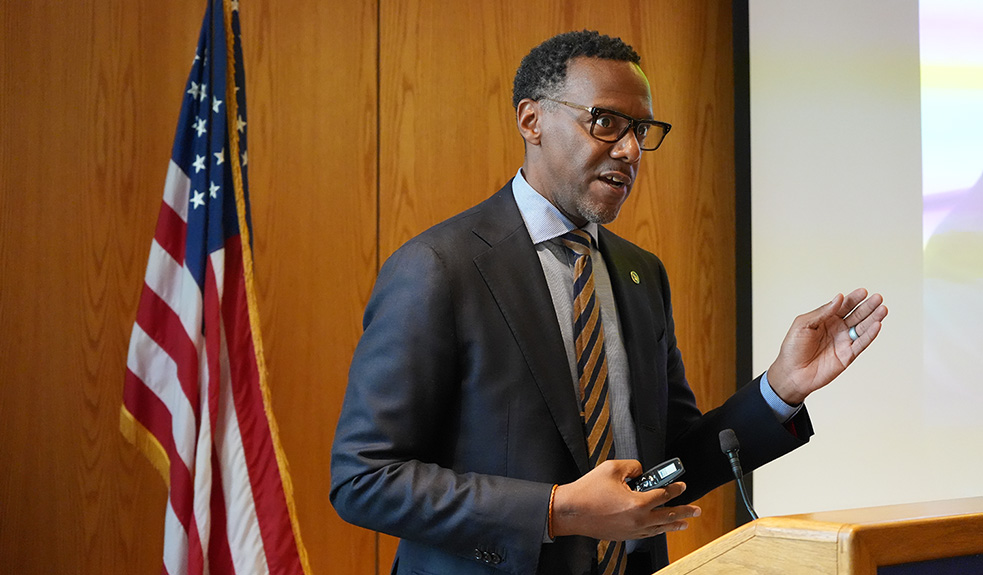
David Wilson, a political psychologist and dean of the Goldman School of Public Policy at the University of California, Berkeley, offered that historic perspective in his keynote address at Maxwell’s Agents of Change conference. He called it “a contest over identity, a contest over us and them.”
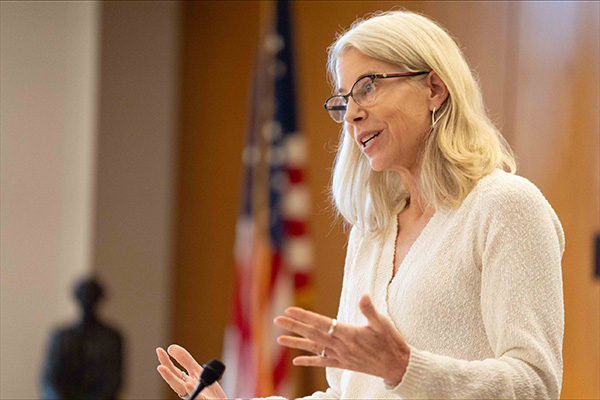
Gadarian, who organized the conference, said the country was “founded on, and struggling with, both a sense of egalitarian ideals and a lived reality of hierarchy.” She framed the first panel conversation around the work of political scientist Rogers Smith, who argues that hierarchies of race, gender, Native status and immigration status were built into America from the start. Who held power was clear: white male landowners. The list of who was shut out was longer, and included women, Black Americans, Native Americans and religious minorities.
Did the founders think about the people who had no voice in the new government? For the most part, no, said Dennis Rasmussen, professor of political science and the Hagerty Family Fellow. For those in southern states, the thought of ending slavery was a dealbreaker, he told attendees.
Rasmussen also delved into the topic during his USA@250 lecture in the spring. He followed abolitionist Frederick Douglass’ grappling with the intent of the founders, eventually believing they were “overwhelmingly hostile to slavery.” Later in life, he said, Douglass “regarded the Constitution as a downright abolitionist charter even before the addition of the Reconstruction Amendments.”
During one of her lectures to the USA@250 class, historian Carol Faulkner did not leave as rosy an impression of the founders’ intent to include women’s rights in America’s great promise. “Jefferson definitely did not intend to include women in the statement, ‘All men are created equal,’” she said. As Rasmussen put it during the conference, Abigail Adams’ famous letter to John Adams, “Remember the ladies,” was taken as a joke.
Among those left out at the founding were the nations of people already living on the land. Aaron Luedtke, assistant professor of history, opens each semester by asking his class what makes Native Americans distinct from every other group. Students say they were here first, they have ties to the land, they live on reservations. All true, he said at the conference, but it misses the legal distinction: sovereignty, acknowledged through treaties the Constitution calls the supreme law of the land. He pointed to what the University’s land acknowledgment, read before many events, leaves out: the present. “What are the ongoing implications of U.S. history?” he asked.
Native history in school, Luedtke said, tends to start with Native people being here first and then drop out after the colonial era. He started a program that sends his Maxwell students into local schools to give seventh graders a fuller picture of the Haudenosaunee. “It’s not that people do not want to know about Native American history,” he said. “It’s that they simply don’t know what they’re missing.”
The same questions were still being argued two centuries later. Historian Mark Schmeller told conference attendees he found them in the 1976 bicentennial, when organizers fought over how Native Americans should take part and whether African Americans would sit on the organizing committees.
The conference conversation around belonging included a spotlight on immigration—a topic examined by Maxwell scholars across disciplines. Economist Thomas Pearson said the immigrant share of the population is near its historic peak, as it was in the late 1800s and early 1900s, before laws pushed it down to 5% or 6% by the 1960s. In each era, he said, the newest arrivals were portrayed as a threat. In a 1920s political cartoon, southern and eastern Europeans were pictured as rats with knives in their mouths, and they were often described as poor candidates for assimilation. Italians, among them, are now held up as a model of that assimilation, while the same doubts are voiced about more recent arrivals.
An audience member who was born in the United States but raised abroad asked who, exactly, Americans are, and at what point enough immigration changes a country’s identity. Pearson said the larger problem is there are so few legal pathways that the system is seen as chaotic. Asked about bipartisanship and immigration reform, fellow panelist Sarah Pralle, associate professor of political science, said majority support often does not become law, and politicians exploit certain lines of division, in this case a “fear of the other.”
‘Wrong, but Excellent Answer’
Another Maxwell political scientist, Mark Brockway, asked conference attendees the question he asks his introductory American politics class every semester, in the same way: What is the first clause of the First Amendment? None of the roughly 1,000 students he has asked has gotten it right, he said.
“Equality for all,” someone in the audience offered. “Wrong,” Brockway said, “but excellent answer.”
He tells students he is wrong all the time, too. The right answer: “Congress shall make no law respecting an establishment of religion.” People tend to read the First Amendment as a limit on what the government can do to us, Brockway said, but the people who wrote the Constitution “were, and we are, the government.” In his reading, the clause asks all of us to leave alone what belongs to each person: “what is in our hearts and what is in our minds, and even what is in our souls, is ours.”
The Constitution was a frequent topic at the conference. In his keynote, Wilson noted that it opens with “We the people,” not “We the government.” Rasmussen talked about the man who he said wrote that Preamble, Gouverneur Morris, a New Yorker with a “wicked, sardonic sense of humor,” who spoke more often than any other delegate to the Constitutional Convention and was the convention’s most outspoken critic of slavery.
In her presentation, Pralle said the country’s founding documents “get all the love,” overshadowing the policies that put their promises to work. If the Declaration and the Constitution are the skeleton, she said, policies are “the meat on the bone.”
That echoed sentiments expressed earlier by Wilson. He said the U.S. treats democracy as “a backdrop against which policy happens, not as something that policy produces.” There is health policy and education policy, he said, but no field devoted to testing ways to strengthen democratic life. His vision: a field of “democracy policy.”
Policy is also the dean’s territory. Van Slyke, who studies public-private partnerships, opened his conference talk with the Erie Canal. After Madison vetoed federal funding, New York committed about $7 million in 1817 to build it on its own. He noted that as federal programs shrink, more public work falls on states, cities and the nonprofits and firms they partner with. “While government can transfer work and risk to its partners,” he said, “its responsibility stays with the public.”
Whether policy delivers is a question sociologist Janet Wilmoth explores in her work. She noted that the Declaration of Independence names life, liberty and the pursuit of happiness as unalienable rights, and asked how well the country has delivered on length and quality of life. Americans live longer than they did a century ago, she told attendees, but life expectancy has stalled and trails other wealthy countries by about four years, even as the United States spends more on health care per person. “Are Americans living longer in better health?” she asked. “Well, no, not now.”
‘An Ongoing Assignment’
In his keynote presentation, Wilson said Maxwell’s founders bet that citizenship could be taught, and that rigorous knowledge and public service belong in the same building. A century later, he said, “the wisdom of that bet is visible in the thousands of Maxwell graduates serving in our city halls, our state houses,” as well as federal agencies and nonprofits.
Sean Callahan ’98 J.D./M.P.A., a longtime U.S. Agency for International Development official and recipient of Maxwell’s 1924 Award, is one of those graduates. He and his wife, Kristin Dadey ’94 B.A. (IR/PSc)/’98 J.D./M.P.A., returned to campus for Family Weekend and attended the conference.
For Callahan, the day offered “optimism that our country is not as bleak as some may perceive,” even as it showed “our democracy was never perfect.” Maxwell, he said, provides “a continuous cadre of prepared and dedicated graduates who want to be valued public servants,” along with “rigorous data, thoughtful research and policy recommendations that are so needed at both the strategic and tactical level of public service.”
Wilson ended his keynote with a charge to match. He said America’s founding “is not a finished inheritance. It’s an ongoing assignment.”
The next generation is already taking it up. Undergraduate international relations major Ethan Leung sat in on the conference, looking for inspiration beyond the classroom. He left asking when bipartisanship begins to have side effects; whether government lacks capital; and where change is really felt, whether local, state or federal. “Conferences inspire me to ask myself questions,” he said.
That brings back Zogby’s question, “What is America?” His own answer began with a word: aspiration. It’s also independence, freedom, the wish to be left alone, a hope for a fresh start, he said. But America, Zogby said, is “equally” a country born of racism, and Americans can no longer tell the story as a “but for” nation, the greatest in the world “but for” slavery, lynchings, the massacres of Native people.
“Learning the full story is not an act devoted to shaming and attacking white privilege,” he said. But the country also needs “a healthy dose of the positive side of the story,” one in which people of color are “not merely seen as victims, but as active agents” in stories of diplomacy, alliance-building, innovation, entrepreneurship and war.
After decades of polling, from red states and blue states to how people abroad see the United States, he stopped. “So who are we?” asked Zogby. “I’m still looking.”
Published in the Fall 2026 issue of the Maxwell Perspective
Lectures for the Nation’s Anniversary
Maxwell’s free USA@250 lecture series explores U.S. history and democracy from the founding era to the present. Its central question: How has the United States lived up to its founding principles of equality, life, liberty and the pursuit of happiness? Thirteen lectures are available in four flights on Maxwell’s YouTube channel.
Related News
School News
Nov 13, 2026
School News
Nov 11, 2026