How the Declaration Still Shapes America: Maxwell Experts on USA’s 250th
By John Boccacino
July 6, 2026
Syracuse University Today
On the “’Cuse Conversations” podcast, Syracuse University faculty break down the ideals behind the nation’s founding and what 250 years of democracy reveal about the U.S. today.
As the United States approaches its 250th birthday, Maxwell School scholars are taking a fresh look at the big ideas that launched American democracy and why they still matter today.
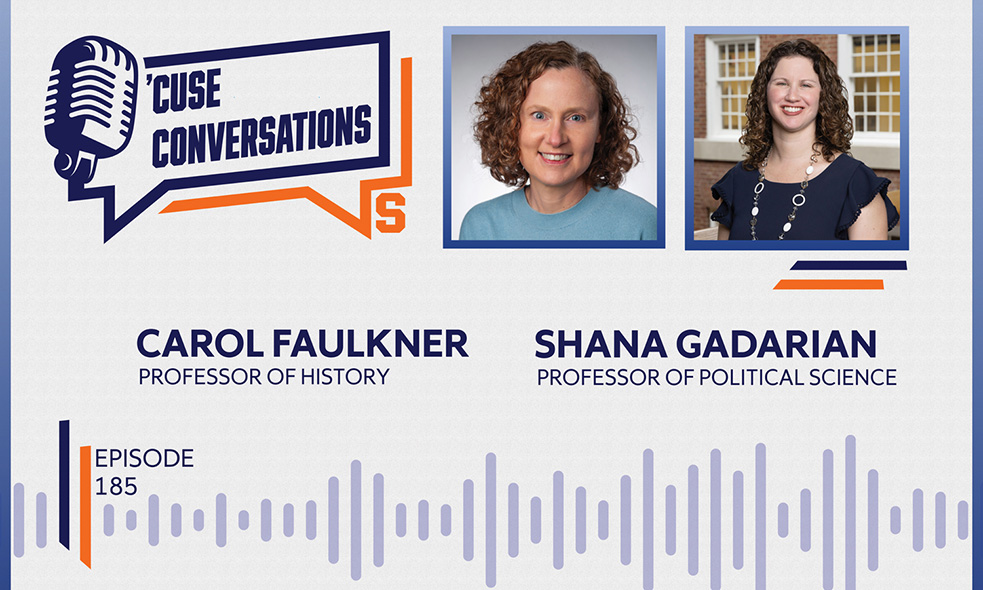
On the latest “’Cuse Conversations” podcast, Maxwell faculty experts Carol Faulkner and Shana Gadarian break down the enduring power of the Declaration of Independence and the debates that shaped the nation’s political identity.
This July 4 marks a milestone Independence Day: America’s Semiquincentennial, with celebrations nationwide reflecting on the country’s founding and its evolving democratic experiment.
At Syracuse University, the Maxwell School led that reflection through USA@250, a free public lecture series exploring U.S. history, politics and society from the Revolution to the present. All sessions are available on Maxwell’s YouTube channel.
Faulkner, professor of history and senior associate dean, and Gadarian, professor of political science and associate dean for research, helped guide those conversations, connecting the founders’ aspirations to the challenges facing American democracy today.
What is the historical significance of the Declaration of Independence?
Carol Faulkner: The Declaration of Independence starts with this great opening with inspiring language about equality, and then it’s a list of grievances against the king and all their complaints about what the king has done wrong.
It was a very aspirational document in 1776. There had never been a document like this before. Some of the colonies had mini declarations before, but not on a national scale. I’m interested in why the revolutionaries chose a “declaration.” To declare something means that you are an independent being with agency, and you are not subject to the king.
What role did political identities play in helping the colonists rally around this idea of American democracy?
Shana Gadarian: Once political identities form, they are very strong in how people think about issues. When people start to think of themselves in terms of being citizens, instead of as subjects, that helps inform a willingness sometimes to set aside material things. That identity is extremely powerful, and it helps the colonists to sometimes give up important material things, like pay and stability, in exchange for something they believe in.
How has our relationship with democracy changed since the founding of the country?
Faulkner: We’re much more democratic than we were at the beginning, but it was a long struggle, and we are still trying to get to a truly democratic society. The Declaration of Independence gave us these ideals to strive for that are not located in other American documents.
The Declaration of Independence doesn’t have legal standing, but Americans repeatedly turn to it for inspiration. The best example close to us is the Seneca Falls Women’s Rights Convention in 1848, which rewrote the Declaration of Independence to include women and listed their grievances against the tyranny of men.
How would you describe the strength of American democracy?
Gadarian: Democracy, fundamentally, is about every person having a voice, but also every person trying to work with others that they may fundamentally disagree with. An enduring democracy is about a willingness to work together and listen to each other, even if you don’t ever change anyone’s mind.
Would the Founding Fathers be surprised that their efforts to launch this nation were still going 250 years later?
Faulkner: They wouldn’t be surprised. They were men with really big egos [laughs]. But I do think our country would be unrecognizable to them, and that’s not a bad thing. Rule number one for historians is the past is a foreign country. You can’t expect people to think, behave and act in the same way that we do today.
Gadarian: The founders would be very surprised about the makeup of who is a citizen and who can participate in government, but they may be less surprised that we still have the same form of government with tweaks around the edges. They designed the institutions of government to be enduring. While there were founders who were concerned that what they’ve set up is temporary, they made it so hard to change our electoral laws and our institutions.
What’s the one lasting takeaway Americans should have as we reflect on the country’s 250th birthday?
Faulkner: America is always trying to be better, and while we can’t necessarily agree on what that better is, all Americans really can view the Declaration of Independence as aspirational and something that joins us together.

Listen to the ’Cuse Conversations podcast via Spotify.
Related News
School News
Oct 27, 2026
Media Coverage
Oct 26, 2026
Media Coverage

Oct 23, 2026