In Memoriam: Edwin Bock
September 26, 2025
Popular Professor, ‘Renaissance Man’
When it was time to register for classes each semester, it was always a race to sign up for those taught by Edwin Bock.
“Everybody I knew was so excited to take his classes,” Chiappetta said, noting that Bock approached his classes as he did life, with tremendous curiosity, and encouraged his students to consider a wide range of views. “He treated you like an intellectual. He gave you scenarios of what was going on in government at the time and challenged you about decisions you'd make.”
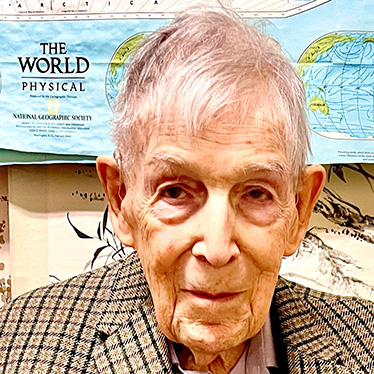
Bock, professor emeritus of political science and public administration and international affairs, taught at Maxwell for more than 30 years. He died on July 28, 2025, in Syracuse. He was 103.
To his loved ones, Bock was a Renaissance man known for his love of books, photography, travel, board games, ballet, classical music, croquet, tennis, poetry, peanut butter, sashimi, black licorice and the Sunday New York Times acrostic puzzle—to name a few. To his former students, he was a beloved scholar and mentor in the field of political science and public administration.
One of his former students, Jacquie Meyer, works as an administrative assistant in Maxwell’s Political Science Department. She took as many courses with Bock as her schedule allowed back in the 1980s when she was pursuing a master’s degree.
“He would engage, and he would draw out,” Meyer said. ‘He was a very good, kind, considerate teacher.”
Chiappetta was especially touched that Bock’s interest in his career continued after he graduated from Maxwell. He said his former professor kept in touch after he moved to Washington, D.C., shortly after graduating. Now, Chiappetta works as a chief executive officer for the Union of American Physicians and Dentists in Sacramento, California.
Bock graduated from Dartmouth College in December 1942 and served in the 97th Infantry Division in Europe and in Japan during World War II. After discharge, he became the civilian director of a War Department Research Unit in the MacArthur occupation government of Japan. In October 1945, he began graduate study and teaching at the London School of Economics and Political Science. He met and married his wife, George Ann Crabtree, in 1950, and moved back to the U.S. a year later.
Early in his career, Bock and his wife began a family and resided in New Jersey while he worked in mid-town Manhattan at the Public Administration Clearing House. In 1954, he became director of the Inter-University Case Program (ICP), which published case studies of government decision-making for use by graduate study programs in political science and public administration.
With the support of the Ford Foundation, Bock and the ICP moved in 1963 to the Maxwell School. He served as president of the ICP while on the Maxwell faculty, teaching courses in national planning, defense, mass media and the arts, and executive leadership, He also helped Asian and European training institutions prepare and use realistic case studies of government policy making and administration.
Throughout his time with the ICP, Bock published 164 case studies surrounding government decision-making and administration. His work spanned 40 years and is archived with the Syracuse University Libraries
Bock was also the author of multiple books. including, The Status of the United Nations Secretariat: Role of the Administrative Tribunal (Chicago, 1954). He was also the editor of a series of case studies about American and comparative public administration.
Bock’s many varied interests included works by the English author Anthony Powell. So much so, in fact, he was among the first members of The Anthony Powell Society, which shared an obituary for Bock on its website.
Bock was predeceased by his wife and great-granddaughter and is survived by five children and many grateful alumni.
“I really appreciate the stellar academic professors that I was exposed to at Maxwell,” Chiappetta said. “But at the top of the list I would put Ed Bock.”
By Jacob Spudich
Published in the Fall 2025 issue of the Maxwell Perspective