In Memoriam: Greg Cook ’12 Ph.D. (Anth)
May 6, 2026
Trailblazing Underwater Archaeologist, Caring Educator
The diving conditions off the coast of Ghana were not ideal: In addition to strong currents, the water was murky and littered with trash and tangles of old fishing nets. Maxwell alumnus Greg Cook dove in anyway.
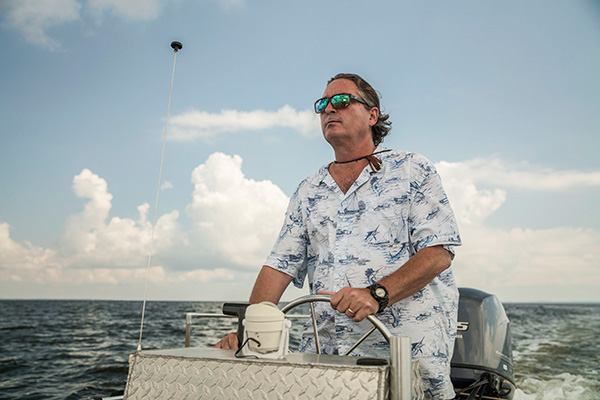
He had made an incredible discovery—the Nieuw Groningen, a Dutch West India Company merchant vessel that, according to historical records, arrived at the Elmina roadstead on Feb. 28, 1647. When anchoring, the crew fired a five-gun salute recognizing the Elmina Castle. A cannon exploded, setting the ship ablaze and causing it to sink, claiming the lives of most of its crew.
Cook, an associate professor of anthropology at the University of West Florida, died April 1, 2026. He was a 2012 Maxwell School anthropology doctoral alumnus whose underwater archaeology work helped reshape understanding of the Atlantic slave trade and Euro-African maritime history.
The 2003 shipwreck find—one of the first major underwater archaeology projects in West Africa—became the focus of Cook’s doctoral dissertation at Syracuse, as well as doctoral projects by subsequent graduate students.
In 2005, Cook led a partial excavation of the site under the auspices of Syracuse University in partnership with the Ghana Museums and Monuments Board and with the support of the National Geographic Society, uncovering new evidence about Euro-African trade interactions along the West African coast. Additional surveys and excavations of the Groningen by Syracuse University were undertaken in 2005, 2007, 2009 and 2013. The wreck lies directly in view of Elmina Castle, which for centuries served as a depot where enslaved Africans were held before being transported to the Americas.
Cook started his college career at Indiana University before receiving a master’s degree in nautical archaeology from Texas A&M University in 1997.
Christopher DeCorse, Distinguished Professor and chair of the Anthropology Department at Maxwell, met Cook at a conference in 1996. They discussed their shared interest in early Atlantic maritime trade and the lack of work that had been done on underwater sites in West Africa. Cook decided to enter the anthropology doctoral program at Maxwell and work with DeCorse on the Central Region Project, an ongoing initiative focused on tracing the contours and impacts of the Atlantic world in coastal Ghana.
“Greg will be remembered for his numerous contributions to maritime archaeology,” said DeCorse. “However, he will be even more remembered as a caring, engaged educator, a kind and gracious colleague, and a good friend. He will be missed by many.”
While at the University of West Florida, Cook directed work at numerous sites in the Pensacola area. As co-principal investigator, he led excavations of the Emanuel Point II and III shipwrecks, the second and third vessels associated with Tristán de Luna’s 1559 Spanish colonization fleet. His fieldwork ranged broadly: he was also part of the archaeological crew that excavated La Belle, one of the ships from Robert de La Salle’s ill-fated 1680s expedition, which sank in Matagorda Bay, Texas, in 1686.
In 2011, Cook received the U.S. Department of the Interior’s Secretary’s Partners in Conservation Award for assisting in an offshore diving project that assessed six submerged cultural resources sites for National Historic Register Eligibility in the Gulf of Mexico.
He directed many field schools and training programs and inspired a generation of students, said DeCorse. He remembered Cook as a “wonderful speaker and raconteur” who could draw on his own experience to move beyond details about individual wrecks and illuminate them as aspects of broader maritime connections.
“He was a gracious, thoughtful colleague who will be sorely missed,” DeCorse said.