In Science, Research Links Genetic Variations in Virus from Wastewater with Community Transmission
By Cort Ruddy
May 14, 2026
The new findings have wide-ranging implications for improvements in the detection and monitoring of a host of communicable diseases.
New research in the journal Science by Maxwell Postdoctoral Scholar Dustin Hill, Professor of Public Health Dave Larsen and a team of researchers, has found a strong connection between the prevalence of genetic variations of the COVID-19 virus and higher community transmission.
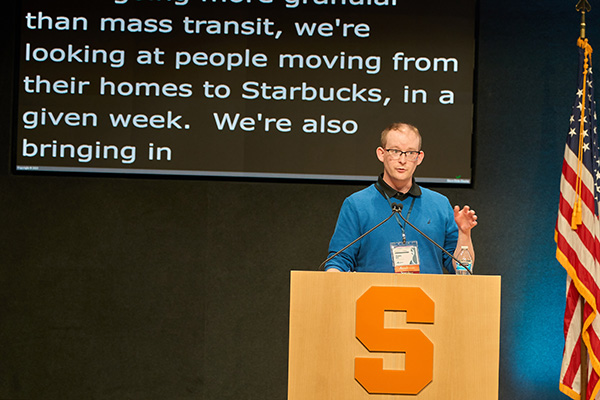
Testing wastewater to detect viruses in a community is a well-established scientific practice. But knowing the prevalence of a disease has always presented challenges–with science relying on sheer volume and concentration of virus load found to make inexact assumptions.
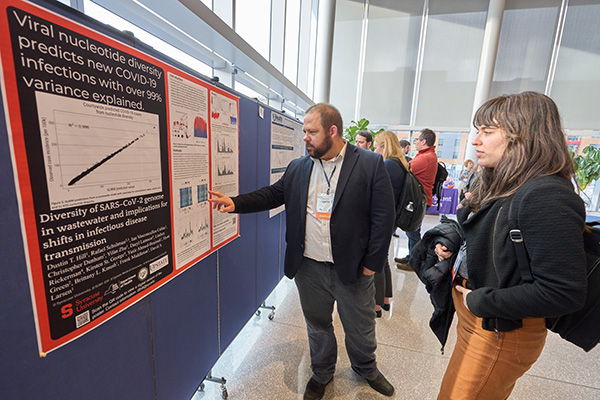
The team, which included colleagues from SUNY Upstate Medical University, SUNY ESF and the New York State Department of Health, looked closely at existing data and genomes from wastewater surveillance collected during the COVID-19 emergency, measuring genetic variation through small, insignificant changes in the virus genome, and comparing that to transmission levels. To put it simply: they found that the more variation in the viral material in wastewater, the more people were infected.
“Not only do infections rise when diversity of the virus increases, infections decline as diversity declines,” says Hill, the study’s lead author. “We tested three different ways to measure diversity of the virus genome in wastewater, and all three measures predicted infections with extremely high statistical power.”
While the study analyzed COVID-19, this connection could change how wastewater surveillance is used not just to detect, but to measure disease transmission with implications for monitoring other diseases, including influenza, measles, polio and future viruses that may arise.
“These findings open up new areas of exploration in genetic epidemiology,” says Larsen. “We will now be able to estimate transmission from sequencing data, something that has previously not been possible.
Key takeaways from the study
- Genetic diversity measured in wastewater is highly predictive of community infection numbers, and superior to current methods that use concentration
- Wastewater genetic data can tell us more than just what variants or subtypes are circulating in each community
- Methods can be applied to any pathogen found in wastewater that can have genetic material sequenced
“This is exactly the kind of research Maxwell exists to support—rigorous, evidence-based and consequential well beyond the laboratory,” said Maxwell Dean David M. Van Slyke. “The collaboration between Professor Larsen, Dr. Hill and their partners at the New York State Department of Health is a model for how transformative research unfolds: without a roadmap, assembling the right collaborators, working through what didn't work, and ultimately arriving at findings that can make communities healthier and safer. The ability to move from detection to prediction changes what policymakers can do, and when they can do it. That's not just scientific progress—that's the public good."
This research project grew from a partnership between Syracuse University, the New York State Department of Health, SUNY Upstate and SUNY ESF that began in March of 2020, in the earliest days of the COVID-19 outbreak.
As the virus first spread in New York and elsewhere, Larsen proposed using wastewater to detect and monitor the virus at Syracuse University. He assembled a team of researchers from Syracuse and nearby universities to begin developing the wastewater surveillance technology that would eventually become critical to New York State’s response to the disease and developed into the New York State Wastewater Surveillance Network.
“The wastewater program was further developed in 2022 by the addition of sequencing of the detected virus, work that was undertaken by the 5-site sequencing consortium set up by the Wadsworth Center in 2021,” said Kirsten St. George Director of the Virology Laboratory at the Wadsworth Center and co-author of the study. “The sequence data generated by the consortium provided the information needed for the genetic variation analysis and transmission correlations reported in this study. Initiated to monitor circulating and emerging variants of the virus, the sequence data generated by the consortium has now proven to be a powerful tool for additional applications.”
In 2024, the New York State Wastewater Surveillance Network was designated as the Centers for Disease Control and Prevention (CDC) Northeast Region Center of Excellence.
“The valuable partnerships the department and our world-renowned Wadsworth Center have developed with Syracuse University, SUNY College of Environmental Science and Forestry and SUNY Upstate Medical University are leading to important new discoveries that are advancing our understanding of not only how to detect COVID in wastewater, but also how to analyze those samples to better predict community transmission,” said New York State Health Commissioner Dr. James McDonald. “The researchers involved in this study remain on the cutting edge of scientific discovery that could change how we look at other pathogens in wastewater, including polio, influenza and measles, and establishing wastewater sampling as a reliable public health early warning system for public health threats.”
This latest research, in the article titled “Genetic Variability of SARS-CoV-2 in Wastewater and Associations with Community Transmission,” appears in the May 14 issue of Science, a leading outlet for scientific news and research.
Related News
Research
Oct 8, 2026
Research

Oct 6, 2026
Media Coverage
Oct 6, 2026