‘Promise of Public Service’ Exhibit Debuts at Maxwell
By Jessica Youngman
September 24, 2026
The traveling exhibit by the National Academy of Public Administration celebrates public servants amid America’s 250th anniversary.
Events and media coverage marking America’s 250th anniversary this year have largely spotlighted historic milestones, founding fathers and revered changemakers. Yet the nation’s foundation—and the durability of its democracy—has depended on a vast, largely unsung network of public servants.
A new traveling exhibit, “The Promise of Public Service,” created by the National Academy of Public Administration (NAPA), aims to put some of those lesser-recognized individuals in the spotlight. After debuting in the Great Hall of the Library of Congress in June, the exhibit’s first stop is the Maxwell School—the nation’s first school of citizenship and public affairs, and home to its top-ranked graduate program in the field.
“There could hardly be a more fitting place,” said Dean David M. Van Slyke during a Sept. 18 reception celebrating the exhibit’s opening in the Maxwell Hall foyer, flanked by the school’s statue of George Washington and the guiding words of the Oath of the Athenian City-State.
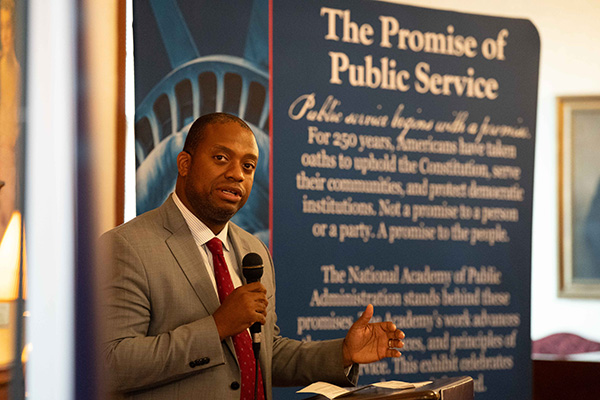
Van Slyke said the oath’s charge—for each generation to leave the world better than they found it—“is part of Maxwell’s history and identity” and central to NAPA’s work. “The DNA of both Maxwell and NAPA is a commitment to public service, a respect for those who undertake it, and the belief that citizenship carries responsibilities to one another and to the greater public good,” he said.
More than 70 living Maxwell faculty members and alumni currently hold the distinction of NAPA Fellow, including Van Slyke. Another connection: James-Christian Blockwood, an adjunct professor for Maxwell’s Washington, D.C., programs since 2022, has served as NAPA’s president and CEO since January 2025.
Maxwell alumnus Wally Bobkiewicz, city administrator of Issaquah, Washington, and a current member of NAPA’s board of directors, was among those who gave remarks during the opening reception.
“Two hundred fifty years in, it would be easy to let the story of public service become a story about presidents and governors and generals,” said Bobkiewicz who received a master of public administration (M.P.A.) in 1989. “This exhibit doesn’t let us off that easy. It puts faces and names to the people who actually make government function day to day.”
Bobkiewicz asked those in attendance to think of the public servants who rarely get noticed. “The public knows the mayor, they know the city council, but they rarely know about the finance clerk who makes payroll,” he said. “Local government runs on thousands of people like that—professional staff who show up and do unglamorous work well.”
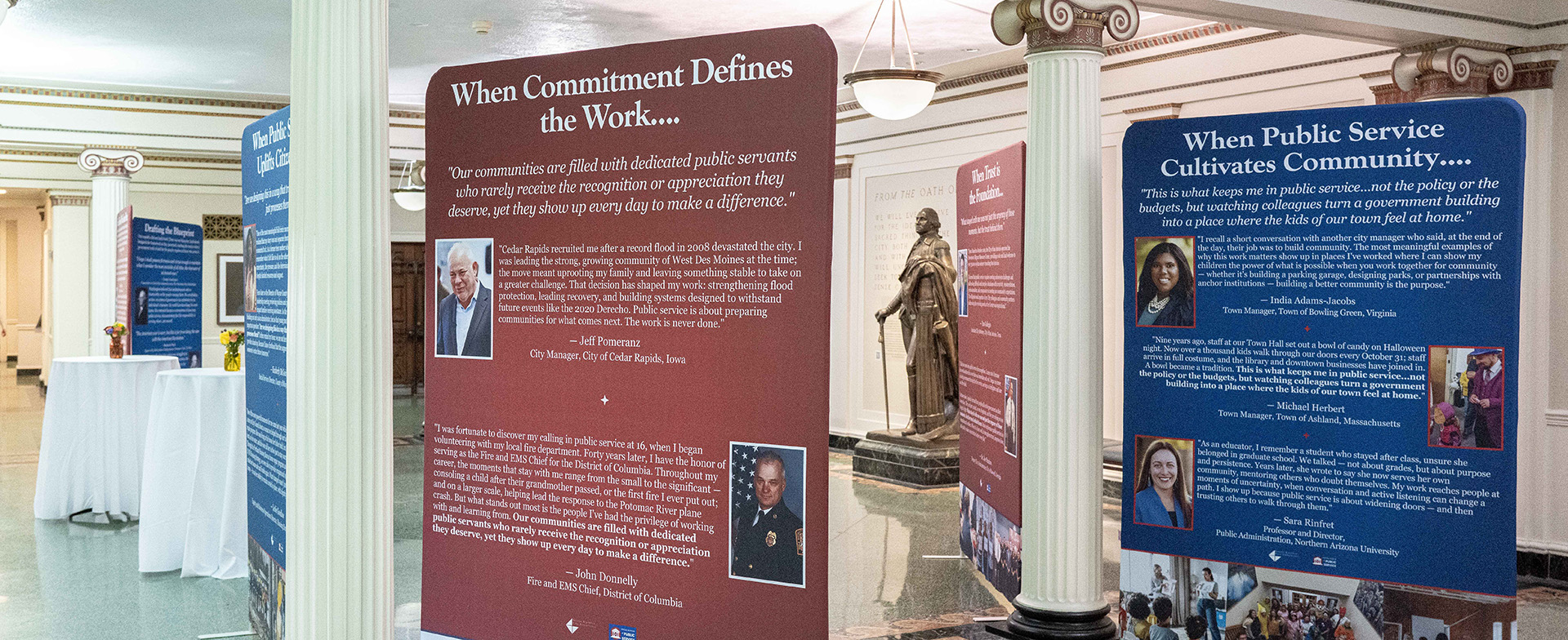
The exhibit at Maxwell features 12 large panels with biographies and photos of individuals such as Kimberly McGuire, social services director for Wayne County, North Carolina, and John Donnelly, fire and EMS chief for the District of Columbia, alongside more prominent figures like George C. Marshall and the late Paul Volcker, a longtime Maxwell Advisory Board member. Marshall served as U.S. secretary of state, U.S. secretary of defense and Army general, and Volcker served five presidential administrations including as chair of the Federal Reserve.
In his remarks, Blockwood described the exhibit as arriving at a consequential moment—one marked by declining trust in institutions, political division and rapid technological change. “The disruption can be positive, depending on how you respond to it,” he said, adding that the exhibit was meant to remind visitors “where we’ve been, who has helped us get here” and to inspire hope in what comes next.
Blockwood reminded the audience that the exhibit tells only a “small part of the story” of public service. He pointed to a guiding belief behind NAPA’s work: “What we nourish grows.” That means creating pathways for the next generation of public servants, he said, supporting those who serve today, and honoring those who have already given so much through lives of service.
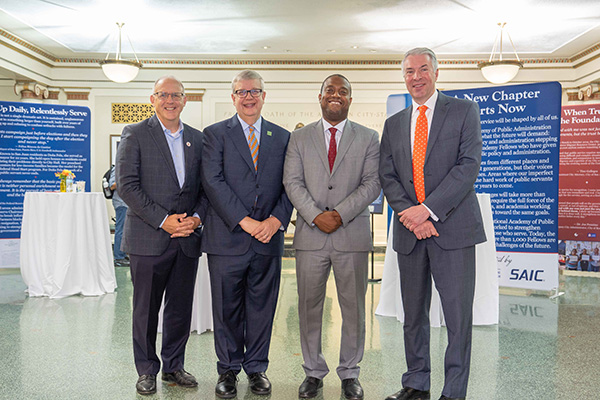
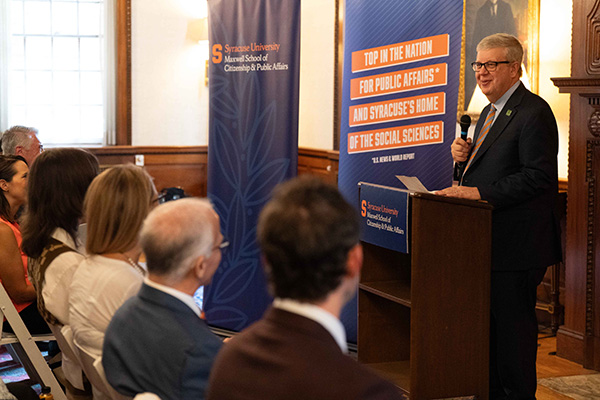
Syracuse University Trustee Stephen Hagerty ’91 B.S./’93 M.P.A. also gave remarks at the event, tracing his own path into public service to a dinner in that same room years earlier. Then-Dean James Steinberg challenged a room of academics and officials to explain why more Maxwell graduates weren’t running for office. Hagerty, one of the youngest people in the room, spoke up in response. Already leading a highly regarded national emergency management company—Hagerty Consulting—he made the decision to run for mayor of Evanston, Illinois, and then won. He led the city through the COVID-19 pandemic, and, separately, his consulting firm has led recovery efforts after Hurricane Andrew, the Sept. 11 terrorist attacks, and, more recently, following the East Palestine, Ohio, train derailment and Southern California wildfires.
“There’s no better way, in my opinion, to spend your time than helping other people,” Hagerty said. He recalled how a similar traveling exhibit on redlining in 2019 helped push Evanston toward becoming the first city in the nation to establish a local reparations program.
The exhibit’s arrival at Maxwell also landed on a milestone day for Syracuse University: the same afternoon the University installed J. Michael Haynie as its 13th Chancellor and President.
Van Slyke pointed to that afternoon’s investiture ceremony in the JMA Wireless Dome. Haynie, a former U.S. Air Force officer, embodies the same values the exhibit celebrates, Van Slyke said, describing public service as “a choice people make to accept responsibility, contribute their talents and place the well-being of others alongside their own ambitions.”
Van Slyke closed the program by thanking NAPA and the Maxwell staff and advisory board members who helped bring the exhibit to campus, and by inviting attendees—students in particular—to spend time with the panels and consider “not only the individuals whose stories are represented, but also the question at the heart of the exhibit: What does public service ask of those who serve?”
“At Maxwell, we believe it asks for confidence and integrity,” said Van Slyke. “But it also asks for humility, courage, curiosity, perseverance and a willingness to work with people whose experiences and perspectives differ from our own. It asks us to see public problems not as someone else’s responsibility, but as an invitation to contribute.”
Related News
School News
Oct 12, 2026
School News

Oct 9, 2026
School News
Oct 6, 2026