Unfinished Business: 77-Year-Old Earns the MPA He Started Five Decades Ago
By Renée Gearhart Levy
May 27, 2026
A dinner conversation, a new laptop and a one-week course in Washington closed a 50-year chapter for Hadwen Fuller.
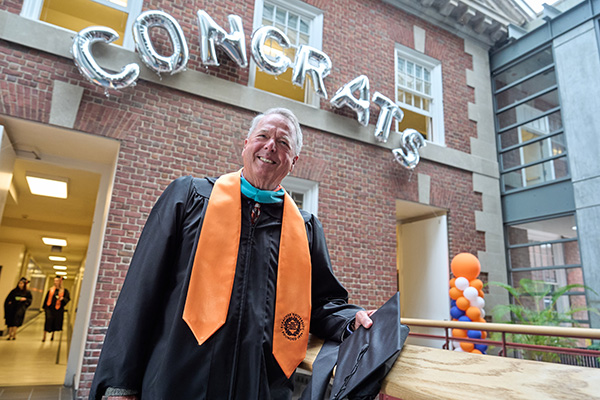
When Hadwen C. Fuller II crossed the stage at the Maxwell School of Citizenship and Public Affairs Graduate Convocation this spring, the loudest cheers didn’t come from his wife and three sons.
They came from a group of classmates young enough to be his grandchildren.
A few months earlier, Fuller had walked into a weeklong January course in Washington, D.C., carrying a brand-new laptop he’d only recently learned how to use, a healthy dose of skepticism about artificial intelligence, and unfinished business that dated back to the Nixon administration.
The three credits earned from that course—Public Management of Technology Development—finally allowed Fuller to complete the M.P.A. degree he had started at Maxwell more than 50 years ago.
“I’ve always liked to finish what I start,” Fuller says.
That persistence has defined much of his life.
He grew up in the Oswego County town of Parish, New York, population 411. His grandfather, despite never graduating from high school, climbed from local politics to the New York State Assembly and, eventually, Congress. Fuller absorbed that example and arrived at Syracuse University thinking seriously about a future in government.
After earning a political science degree from Maxwell in 1970, Fuller enrolled in the College of Law. In his second year, he added a public administration degree at Maxwell because it matched his interest in leadership and public service.
He finished law school in 1973. The M.P.A. stalled six credits short.
For many people, that unfinished degree would have faded into ancient history. Fuller carried it around like a pebble in his shoe.
“It just kind of gnawed at me that I never completed it,” he says.
Over the next five decades, Fuller built a varied and successful professional career. Shortly after law school, he served as justice of the peace in Parish, processing thousands of cases after state police flooded the area with traffic enforcement teams. He worked in his family’s Sunoco gasoline distributorship, eventually selling the business during the 1980 Lake Placid Olympics while helping coordinate corporate fundraising tied to the Games. Most of his professional life has been spent in the aviation fuel industry, launching and running companies of his own.
Along the way, he took another swipe at the Maxwell degree. In 1996, he petitioned to re-enroll and completed a three-credit course on management of the U.S. Forestry Service.
“I planned to enroll in another class to finish it up,” Fuller says. “It just never happened.”
Until a dinner conversation changed everything.
Last fall, Fuller attended an event hosted by the Onondaga Historical Association, where he serves on the board. One of the guests was Brynt Parmeter, newly arrived at Maxwell as professor of practice in public administration and international affairs and the Phanstiel Chair in Leadership.
At some point during the evening, Fuller casually mentioned he was “almost” a Maxwell alumnus. Parmeter quickly learned Fuller was only one course away from finishing the degree he had started in the early 1970s. By coincidence, Parmeter himself was teaching a one-week, three-credit course in Washington that January.
“Would you like to finish your degree?” Parmeter asked.
Fuller thought he was joking.
He wasn’t.
I couldn’t believe that someone with that level of experience still wanted to be in a classroom, still wanting to learn. That shifted something for me, not just how I saw Had, but how I see things in general. No matter how much experience you have or how much you know, there’s always more to learn.”
Lauren Grosso ’26 M.P.A.
Soon, Assistant Dean of Online Programs Nell Bartkowiak was digging through decades-old records and untangling the academic equivalent of an archaeological dig. Expired credits needed reinstating. Approvals had to move through faculty leadership, the Graduate School and the registrar. Fuller had to be transferred into the executive M.P.A. program.
And then there was the technology.
“From soup to nuts, he needed help with everything,” Bartkowiak says with a laugh. “But he was a very good sport about it.”
Despite decades of business success, Fuller had largely managed to avoid becoming computer savvy. Bartkowiak convinced him he needed a laptop.
After a trip to Best Buy, Fuller launched into what amounted to a crash course in modern technology, teaching himself how to use the computer while diving headfirst into AI.
By January, he arrived in Washington equal parts prepared and panicked.
His classmates included M.P.A. students, international relations students, law students and U.S. State Department fellows. Nearly all of them were decades younger. Fuller worried he would slow down group work or embarrass himself trying to keep up.
Instead, he became an integral member of the class.
Lauren Grosso ’26 M.P.A. initially thought Fuller was a guest speaker before realizing he was a fellow student. “I couldn’t believe that someone with that level of experience still wanted to be in a classroom, still wanting to learn,” she says. “That shifted something for me, not just how I saw Had, but how I see things in general. No matter how much experience you have or how much you know, there’s always more to learn.”
The course itself focused on public policy scenarios set in 2030, challenging students to use AI tools to solve complex problems while also evaluating the technology’s weaknesses and risks. For Fuller, it became a revelation.
“It’s like you have the smartest person in the world sitting next to you,” he says of AI. “They don’t get tired. They’re up all night. And you can ask them dumb questions because they don’t care.”
Still, Fuller wasn’t simply absorbing lessons. He was teaching them too.
During discussions, he connected classroom theory to decades of firsthand experience in business, law, leadership and government. He talked openly about mistakes, setbacks and decisions that looked better in hindsight than they did in the moment.
“Sometimes making or knowing about the wrong decision is also as important as knowing what could be a good decision,” he says.
The dynamic quickly became one of mutual exchange. Students helped Fuller navigate digital tools and technology. Fuller offered career advice, networking wisdom and perspective forged through decades of real-world leadership.
“He was always engaged and genuinely happy to be there, and that attitude was contagious,” says Alaina Kaslewicz, a Maxwell graduate assistant and M.P.A. student. “I think everyone looked forward to interacting with him because he was not only incredibly accomplished, but also kind, curious and excited to learn alongside everyone else.”
Outside the classroom, Fuller became a popular companion.
Students invited him to coffee, dinners and outings around Washington. Fuller jokingly refers to himself as “the class pet,” but the affection clearly ran both ways.
“I’m 77 years old and many of these students were younger than 27,” he says. “Having this intergenerational education experience was wonderful and something I would recommend to anyone, even if you don’t want to complete a degree.”
For Bartkowiak and Parmeter, Fuller’s story reflects something important about the Maxwell community.
“Pursuing graduate study is a huge investment of time, money and energy, and oftentimes life gets in the way,” says Bartkowiak. “Students should know that we’re here to help them persist and complete their program whenever they’re ready to re-engage with us.”
“It’s really a reflection of the Syracuse University culture,” adds Parmeter. “We will always remain engaged with you in your journey to learn.”
This spring, Maxwell celebrates several graduates who completed degrees that were started decades ago.
Salvador del Solar, a Maxwell M.A. student in international relations, took a hiatus from a successful acting career in Peru to study at Maxwell in 2001. After years dedicated to cultural promotion in his country, he served as Peru’s minister of culture in 2017 and prime minister in 2019. In April, he returned to Maxwell to present “Elections Without Representation: Peru and the Limits of Democracy,” which he presented as his master’s thesis.
Jake Tanksley, a Syracuse University alumnus who spent a decade working toward an executive M.P.A. while employed in human resources at Syracuse University, used remitted tuition benefits to slowly chip away at the degree while balancing work and life. Now vice president of human resources at Lincoln University, Tanksley completed the M.P.A. this year as well.
For Fuller, what began as an effort to check a lingering item off his to-do list ultimately became something much bigger: proof that it is never too late to learn, reconnect with a community or finish what he started.
His participation in Convocation came at the urging of his classmates. “There wasn’t any reason for me to walk,” Fuller says, “except that I realized I wanted to see them walk.”
As it turns out, “It was kind of a thrill,” he says.
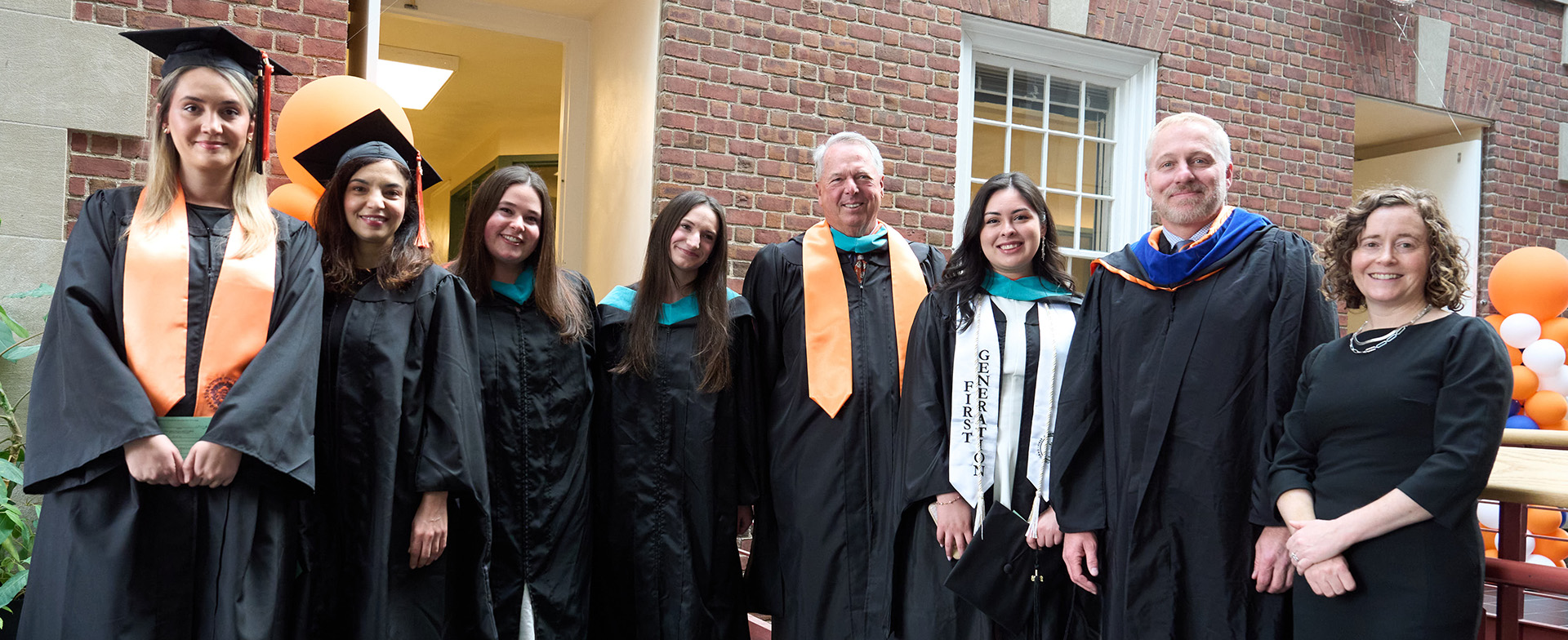
Top photo: Hadwen C. Fuller II is shown with fellow class of 2026 graduates and two members of the Maxwell community who were determined to see him complete his degree: Brynt Parmeter and Nell Bartkowiak.
Related News
School News
Oct 5, 2026
School News
Sep 24, 2026
School News

Sep 16, 2026