National Security Management Course Brings Together Military Leaders for Intensive Education
By Cort Ruddy
June 23, 2026
From international law to executive power, Maxwell's national security studies program tackles the defining security questions of the moment.
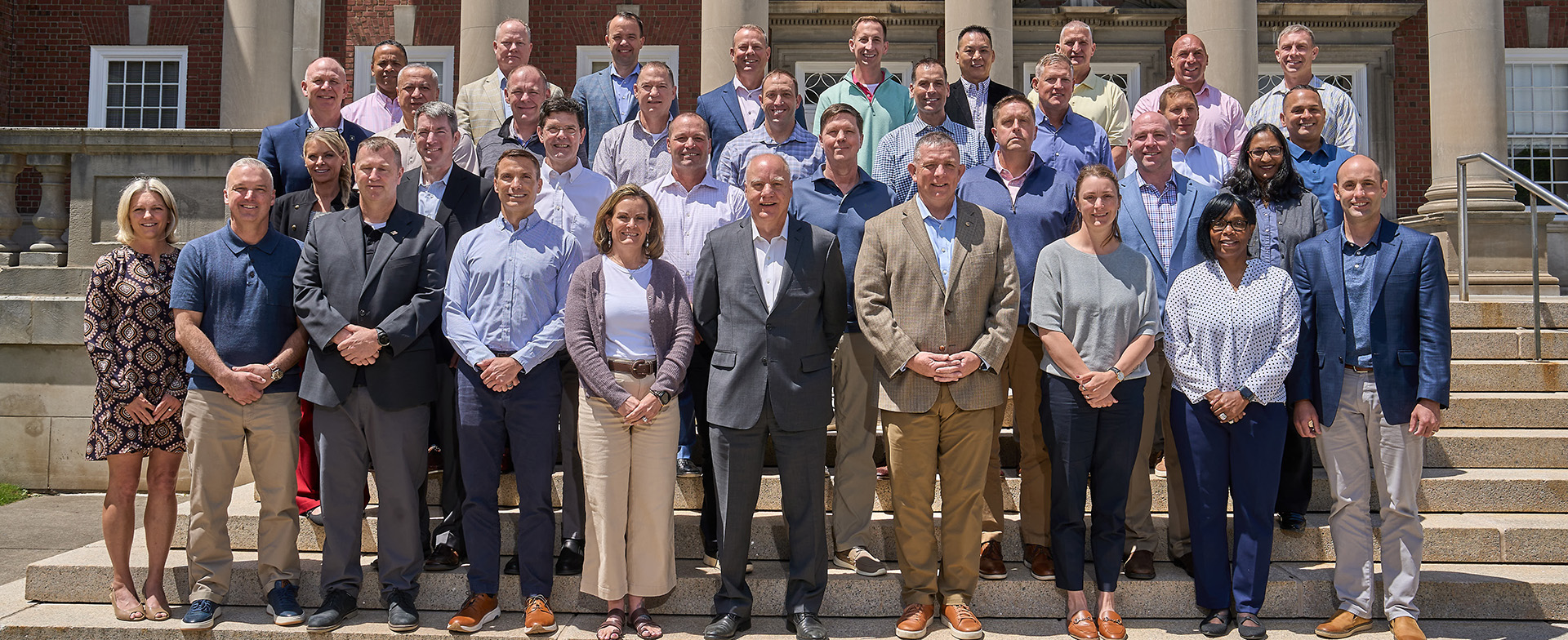
“You are about to get all the content for a semester-long, 6-credit-hour course in national security law in about three hours, give or take,” Steve Grundman, program manager for National Security Studies at the Maxwell School of Citizenship and Public Affairs, told 40 high-ranking officers, non-commissioned officers and civilian officials from the U.S. defense establishment as a seminar with The Hon. James E. Baker was about to begin.
It was that kind of week.
The Maxwell School's National Security Management (NSM) course recently brought these participants together for an intensive week-long examination of the complex landscape of contemporary national security. It was the culmination of a seven-week course that begins with online sessions featuring civilian and military experts, which this spring included former U.S. Ambassador to Israel James Cunningham and General James Cartwright, former vice chairman of the Joint Chiefs of Staff, among others. The on-campus phase features Maxwell’s expert faculty and still more experts, with the recent agenda including a talk with former Deputy Secretary of Defense Kathleen Hicks, speaking on the topic of “Leading through Uncertainty.”
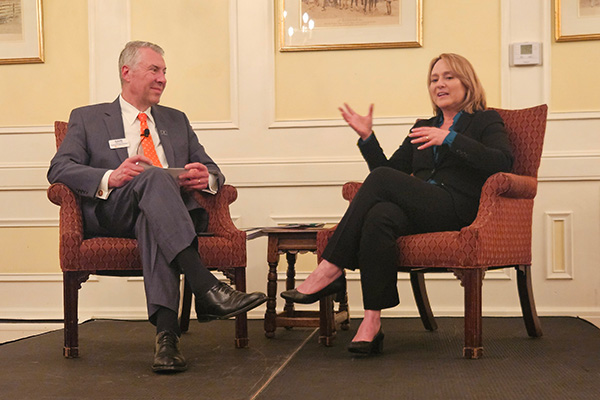
“Dr. Hicks led the day-to-day operations of the Defense Department through the most consequential period in global security since the end of the Cold War,” said Maxwell Dean David M. Van Slyke. ”Having her speak with our participants—leaders who are themselves navigating that landscape—and discussing valuable lessons learned is exactly what this program is designed to do.”
The NSM course, offered each spring and fall, is one part of a broader National Security Studies portfolio that Maxwell has built in partnership with the Department of Defense, and serves as both an anchor of the Executive Education Department and a cornerstone of Syracuse University's deep, enduring commitment to serving the men and women who serve the nation.
In the session with Baker, a professor by courtesy appointment of public administration and international affairs at Maxwell and a former chief judge of the U.S. Court of Appeals for the Armed Forces, participants explored the fundamentals and frontiers of national security law, from constitutional theory to the strategic implications of Russia's invasion of Ukraine. He did not soften the moment.
“What makes these challenges today so complex?” Baker asked participants. Three things, he said, “First, these challenges come with a new age of technology.” He cited artificial intelligence, synthetic biology and our technological dependence on near-Earth space for communications and navigation.
The second complicating factor, Baker argued, is a crisis in the legitimacy of international legal norms, including the fundamental respect for international borders.
“Russia's full-scale invasion of Ukraine is a statement that no law matters,” Baker said. “It is the right of the powerful to take from the weak, and that has fundamentally eradicated our understanding of what international law has been.”
On the domestic side, Baker pointed to deepening debates over the boundaries of executive power—what legal scholars call unitary executive theory—as another factor undermining law as a stabilizing force.
Baker's third reason is deep division within the United States.
“It's hard to do things in the international security sphere if you only bring along half the country,” Baker said. “The United States is most powerful when it speaks with one voice, and it speaks with all three branches.”
Yet Baker's message was ultimately one of institutional hope. Despite the turbulence surrounding law and governance, he argued that the U.S. military stands apart as a model of professional restraint and accountability.

“The United States military is still the finest military in the world,” he said, describing its superpower as twofold: its adherence to the law, and its nonpartisan, apolitical character. Baker, who began his long career as an infantry officer in the U.S. Marine Corp, added, “That is different than most militaries. And that stands out.”
He noted that the military remains the only American public institution in which more than half the country—62 percent, according to a recent Gallup poll—expresses high confidence. “Law is not an impediment,” Baker concluded. “It is a feature and virtue of the U.S. national security system, if you use it wisely and well.”
Baker's session was one of many that challenged participants to think beyond their immediate operational environments through lectures, discussions and case studies tailored to senior executives who grapple with the challenges of national security decision making. Attendees also participate in simulations that put all the skills they discuss and learn to the test.
The National Security Management course has deep roots and a long history, starting in 1996 and growing steadily in prestige and scope. Upon completing the program, participants receive a national security management certificate—and often also earn professional development credits in their organizations that can help with merit-based promotion.
Most recently, Maxwell expanded the scope of its national security offerings with a course geared for midcareer professionals: The Discipline and Practice of Strategy, which was developed in collaboration with the Strategic Development and Initiatives office of the U.S. Army. The course has featured distinguished faculty including Lawrence Freedman, emeritus professor of war studies at King's College London; Rita McGrath, professor of management at Columbia University; and the former chief talent management officer at the Department of Defense, Brynt Parmeter, who now holds the Phanstiel Chair in Leadership at Maxwell.
“We've been imagining courses for those a little bit earlier in their careers,” noted Steve Lux, director of executive education, signaling Maxwell's ambition to expand its national security education pipeline beyond senior flag officers to the next generation of military strategists.
That ambition aligns naturally with Syracuse University’s identity as one of the most veteran-friendly research universities in the country.
For the officers and others who participated in last week’s course, what Baker said about the unique demands of national security legal reasoning likely resonated well after the session ended.
“There are a lot of smart lawyers in the world,” he told them. “But there are a lot fewer smart lawyers in the world who are prepared to make decisions on national security timelines and be held accountable for them.” He said, “You don’t get to go back and research it and study it. You have to put it on the table right there.”
Those are stakes members of the national security establishment can understand, and the very situations Maxwell's National Security Management course has been preparing them to grapple with for 30 years.
Related News
Research
Oct 8, 2026
Research
Oct 6, 2026
School News
Oct 6, 2026