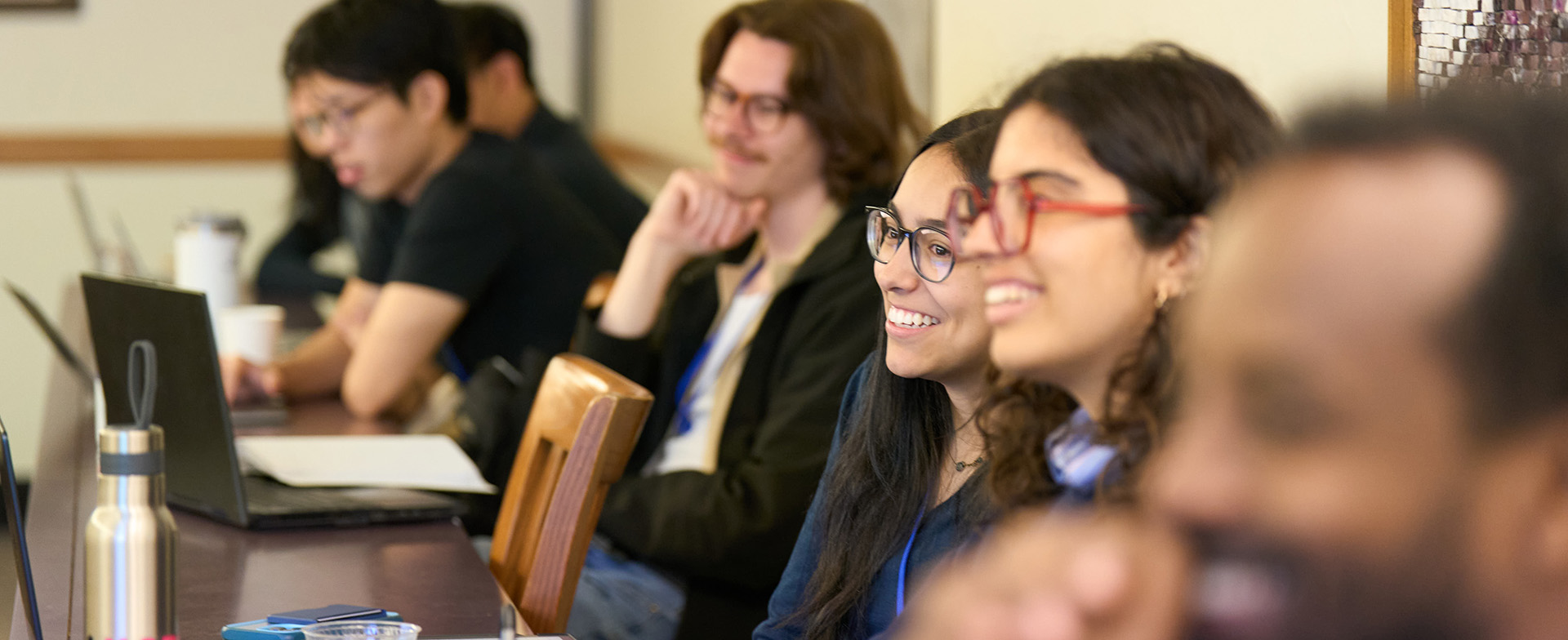
Where the World’s Researchers Come to Learn Their Craft
By Jessica Youngman
July 27, 2026
The Institute for Qualitative and Multi-Method Research draws graduate students and scholars from around the globe to Maxwell.
This summer, 162 researchers from Yale, Oxford, the London School of Economics, Princeton, Columbia and dozens of other leading institutions from every continent except Antarctica traveled to the Maxwell School for the Institute for Qualitative and Multi-Method Research.
The institute, referred to as IQMR by attendees and alumni, wrapped its 24th year and its 16th at Maxwell in late June.
“The institute’s annual presence at Maxwell shows the school’s stature as a leading place for social science research and training,” says event organizer Sebastian Karcher, a research associate professor of political science at Maxwell. “And the fact that this year saw one of the highest attendance signals how much social scientists around the globe value the training and opportunities provided by the institute.”
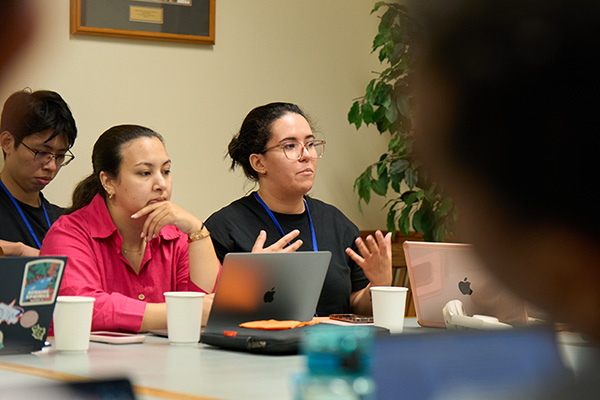
Karcher explains that qualitative and multi-method research is vital to understanding critical dynamics in the U.S. and around the world. Qualitative data can be almost anything that isn’t a number—interview transcripts, historical documents, photographs and even a researcher’s own field notes from watching an event unfold. The real skill, taught at IQMR, lies in checking that material against itself, comparing sources and revisiting them over time so the conclusions hold up. Researchers learn to leverage and triangulate different forms of qualitative data to build findings that have validity and reliability.
The annual institute meets a need: While most researchers and Ph.D. students have ample access to training in quantitative methods, which includes statistical analysis and correlation research of large data sets, exposure to qualitative research methods, techniques and expertise is scarcer.
“From political parties to populism and policymaking and protest, qualitative methods help people understand not only the why but also the how of foundational social, economic and political processes,” Karcher says. “IQMR trains researchers to investigate those mechanisms rigorously.”
The institute is hosted at Maxwell by the Center for Qualitative and Multi-Method Inquiry (CQMI), which Karcher directs along with the related Qualitative Data Repository—a first-of-its-kind archive that stores and shares the data underlying qualitative and multi-method research worldwide.
Since its founding in 2002, IQMR has trained more than 3,500 researchers. Karcher estimates that almost 3,000 of them have attended the institute at Maxwell.
The institute’s annual presence at Maxwell shows the school’s stature as a leading place for social science research and training.”
Sebastian Karcher
research associate professor of political science and director of the Center for Qualitative and Multi-Method Inquiry
Attendees chose from more than a dozen module sequences led by leading scholars in the social sciences. This year’s topics ranged from ethnographic methods and comparative historical analysis to geographic information systems, research ethics and approaches that blend qualitative insight with machine learning. Additionally, the institute offered sessions where participants put their own research designs on the table and heard frank feedback from peers and faculty.
“IQMR alumni form a global community,” says fellow organizer Christiane Pagé, associate director of CQMI. “They maintain friendships and collaborations decades after the institute and are represented on the faculty of many of the leading political science departments in the world. And whenever they return to Maxwell be it for an invited talk, as IQMR instructor or as Maxwell faculty member, it’s a little bit like a homecoming.”
Eleven current Maxwell faculty members are institute alumni, including Seth Jolly, chair of the Political Science Department. He says IQMR was a pivotal experience during his graduate studies. “I met amazing instructors from all over, whose work I had read in classes,” he says. “The peer networking was just as important. Intellectually, it was transformative for my dissertation project and my future research and, socially, it expanded my peer network immensely.”
For many, the institute has shaped how they think about research—not just the methods they use, but the questions they ask.
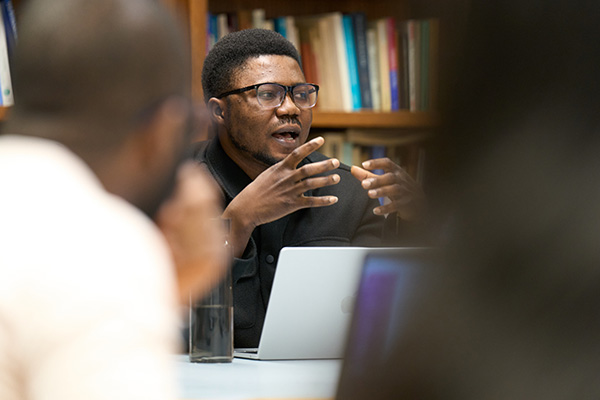
The institute’s influence extends well beyond the two weeks on campus. Doctoral students who met at IQMR have gone on to become long-term research collaborators, most recently contributing to Doing Research as a Native: A Guide for Fieldwork in Illiberal and Repressive States (Oxford University Press), a volume addressing one of the most urgent challenges in contemporary field research, edited by Kira Jumet of Hamilton College and Merouan Mekouar of Canada’s York University; they met at IQMR in 2011.
“Sixteen straight years of researchers from major institutions choosing to come train at Maxwell says something about where this school stands,” says Shana Gadarian, associate dean for research and professor of political science. “IQMR gives them the training to do rigorous work on pressing questions about political institutions, democracy and public policy.”
Gadarian and Maxwell faculty colleague Brian Taylor gave remarks at this year’s institute.
One of the highlights of this year’s lineup was an evening event that had participants gather with faculty over mocktails for informal, one-on-one conversations about their thorniest methodological questions. These informal exchanges between faculty and participants leave some of the most lasting memories.
“I came in hoping to learn more about qualitative methods, but I left with much more than that: many wonderful friends, meaningful feedback on my research, and so much inspiration to do better research,” says Kaniz Fatema, graduate student in sociology at the University of Kansas.
Top photo: From left, Jae Chang and Erik Ackroyd of The Ohio State University, Isabella Marin of Columbia University, Mariam Ben Slama of Johns Hopkins University, and Girma Milo Alemu of Ardhi University.
Related News
School News
Sep 24, 2026
School News

Sep 16, 2026
School News
Sep 15, 2026
School News
Sep 10, 2026