Bosnian Fluxes, Belonging, Caring, and Reckoning in a Post-Cold War Semiperiphery
Azra Hromadžić
Routledge Taylor & Francis Group, August 2025
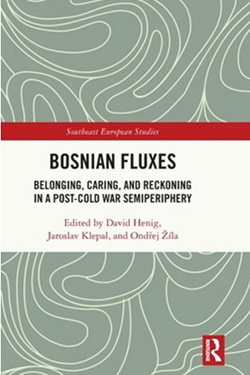
Azra Hromadžić, professor and undergraduate director for anthropology, has contributed to a recently published book, Bosnian Fluxes: Belonging, Caring, and Reckoning in a Post-Cold War Semiperiphery (Routledge, 2025).
The book brings together multiple researchers and scholars to delve into the aftermath of the Cold War in Bosnia and Herzegovina. They focus on social, political and economic trends and effects on ordinary lives in the country.
Hromadžić’s chapter, “Seeing like a social worker,” is one of eight and harnesses her ethnographic fieldwork in the city of Bihać to show the importance of social workers in the country as well as the importance of relationships and social connections to “enable the state to become, however partially, visible and (semi-)legitimate to people.”
Hromadžić also authored Riverine Citizenship: A Bosnian City in Love with the River (Central European University Press, 2024). She is a Laura J. and L. Douglas Meredith Professor for Teaching Excellence, a senior research associate at the Program for the Advancement of Research on Conflict and Collaboration, and the Center for European Studies and is a faculty affiliate with the Aging Studies Institute.
From the publisher:
This volume offers unique conceptual and empirical insights into ordinary lives in the violent aftermath of the Cold War. Considering Bosnia and Herzegovina as a comprehensive coordinate of larger social, political, and economic fluxes, it demonstrates why the widely used tropes of stuckedness, immobility, and frozenness associated with post-Cold War semiperipheries need to be understood in the context of excessive upheavals that mobilise or suspend modes of belonging, care, and reckoning. Bringing together emerging and leading scholars from across the social sciences with long-term research experience in Bosnia and Herzegovina, along with scholars who have been documenting similar processes in other parts of the world, this volume develops new analytical heuristics and interventions into global post-Cold War studies. It will be of particular interest to researchers and students of Anthropology, Sociology, Human Geography, Contemporary History, and Area Studies along with those studying the history, politics, economy, and culture of semiperipheries.
Published in the Fall 2025 issue of the Maxwell Perspective
Related News
Research

Oct 7, 2026
Media Coverage

Sep 18, 2026
Media Coverage
Aug 27, 2026