How Commerce Became Legal: Merchants and Market Governance in Nineteenth-Century Egypt
Omar Cheta
Stanford University Press, September 2025
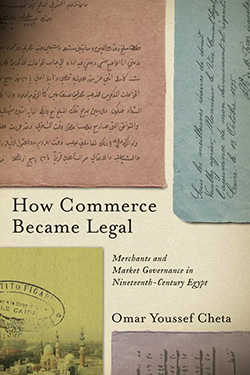
Omar Cheta, assistant professor of history, has written How Commerce Became Legal: Merchants and Market Governance in Nineteenth-Century Egypt (Stanford University Press, 2025).
The book explores Egypt’s adoption of a new infrastructure of commercial laws and institutions following the country’s opening to private capital in the 1840s. This shift reflected the status of Egypt as a “site of profound legal experimentation,” Cheta maintains, as he examines the legal and business practices that resulted from the fusion of Ottoman, French and Islamic legal concepts in Egypt.
Cheta’s research focuses on the country’s history from the 1840s to the 1880s to better understand how modern laws influenced the current mode of market regulation in Egypt. Throughout the book, he relies on individual experiences and structural explanations, while offering an original viewpoint on the magnitude of market regulation.
Cheta is a senior research associate in the Middle Eastern Studies Program. His work has been published in multiple journals, including Past and Present, International Journal of Middle East Studies and History Compass. Last year, Cheta wrote "Hostages of Credit: The Imprisonment of Debtors in the Khedival Period,” a chapter in The Oxford Handbook of Modern Egyptian History (Oxford University Press).
Earlier this year, Cheta was honored with a Teaching Recognition Award from the Middle Eastern Studies Program at Syracuse University. He’s also been awarded the Appleby-Mosher Grant, a university grant named after the first two deans of the Maxwell School, William E. Mosher and Paul H. Appleby. Cheta was one of numerous Maxwell recipients of the grant for the 2024-25 academic year.
From the publisher:
When Egypt's markets opened to private capital in the 1840s, a new infrastructure of commercial laws and institutions emerged. Egypt became the site of profound legal experimentation, and the resulting commercial sphere reflected the political contestations among the governors of Egypt, European consulates, Ottoman rulers, and a growing number of private entrepreneurs, both foreign and local. How Commerce Became Legal explores the legal and business practices that resulted from this fusion of Ottoman, French, and Islamic legal concepts and governed commerce in Egypt.
Focusing on the decades between the formalization of Cairo's practical autonomy within the Ottoman Empire in the 1840s and its incorporation into the British Empire in the 1880s, Omar Cheta considers how modern laws redefined the commercial sphere, shaping a mode of market governance that would persist for decades to come. He highlights the demarcation of a new law-defined commercial realm separate from the land regime and from civil or family-centered exchanges and reconstructs these changes through both legal codes and state orders, as well as individual merchant voices preserved in court documents. As this book documents both individual experiences and structural explanations, it offers a rare perspective on the scope and reach of market governance over the mid nineteenth century, revealing changes simultaneously from within and without state institutions.
Published in the Fall 2025 issue of the Maxwell Perspective
Related News
Media Coverage

Oct 5, 2026
Media Coverage

Oct 1, 2026
Research

Sep 29, 2026