Expert on the Arabian Peninsula Traces Gulf's Past, Present and Uncertain Future in Maxwell Talk
March 13, 2026
Distinguished Diplomatic Fellow at the Middle East Institute Daniel Benaim offered a sweeping analysis of America's relationship with the Gulf states.
As the conflict in the Middle East and the Gulf made headlines, the Maxwell School welcomed Daniel Benaim, former deputy assistant secretary of state for the Arabian Peninsula and former speechwriter for President Joe Biden, for a timely discussion with international relations and political science students, faculty and staff.
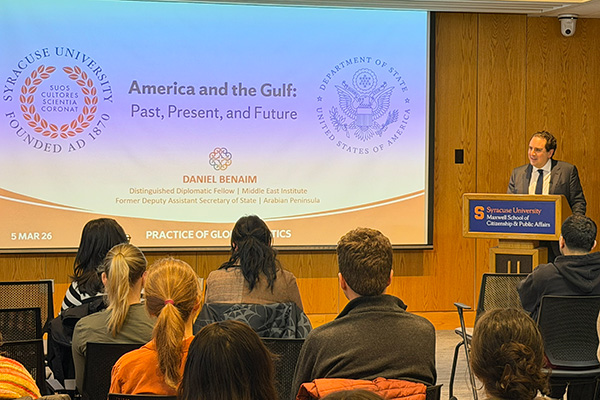
The event, titled “America and the Gulf: Past, Present, and Future,” was part of the Moynihan Institute's Practice of Global Politics series and was organized by Michael John Williams, associate professor of public administration and international affairs and director of the master of arts in international relations program.
“While the outbreak of war in the Gulf naturally commands attention,” said Williams, whose Transatlantic Security Issues Seminar (PAI 714) attended the event. “Dan Benaim was uniquely able to place the current conflict with Iran within the broader arc of regional development and the Gulf's future ambitions. In doing so, he provided insight and analysis rarely found elsewhere—meaningfully enriching the student experience at Maxwell.”
Benaim opened his remarks by laying out two distinct images of the Gulf region: one that tells a story of the past, as exemplified by the Iranian Revolution of 1979, and the other of a possible future, most notably articulated by Saudi Vision 2030—an ambitious plan for a more diverse economy and vibrant society for the kingdom, with implications for all six members of the Gulf Cooperation Council (GCC), which also includes the United Arab Emirates (UAE), Qatar, Bahrain, Oman and Kuwait.
“The Gulf really contains multitudes,” said Benaim, qualifying his framework and expressing the true complexity of the region. “They're the richest energy suppliers and the richest clean energy investors. They're the mediators for all kinds of peace, and the instigators of a few challenges in a few places. They are a place that was responsible in the past for a lot of extremism. I think, today, it is probably the most promising and exciting place pushing back on the idea of religious extremism in favor of a different vision for the future.”
Benaim traced the foundations of U.S.-Gulf partnerships to a meeting between Franklin D. Roosevelt and King Abdulaziz Ibn Saud of Saudi Arabia on the USS Quincy in 1945, a moment Benaim described as the origin point of “an energy partnership that really helped build a lot of the modern economic DNA of Saudi Arabia.” He walked the audience through major events that followed, including Cold War alignments, the Carter Doctrine, the liberation of Kuwait, and the counterterrorism cooperation after September 11 between the U.S. and many Gulf states.
He described a shift in Gulf leadership, a younger generation, that has reoriented the region toward that “2030” Gulf vision. Leaders, as Benaim put it, “who are as comfortable in a multiplayer video game as they are in a royal palace.” He called it “a revolution from above” to remake Gulf societies, expand opportunities for women, introduce entertainment and culture, and shift the basis of legitimacy from religion and family to something more nationalist and dynamic. He was also careful to note the contradictions, as these governments continue to be dynastic and authoritarian.
Laying a foundation for understanding the region and its trajectory, Benaim then turned to the current war and its implications.
“In the first hours of this war, the missiles began falling on these same Gulf countries,” Benaim said, noting that the Gulf states, so focused on a more vibrant future, were apprehensive about the objectives of the military action, seeing Iran as “effectively contained” prior to the U.S. and Israeli action. But, as it began, Iran immediately tried to “regionalize the conflict,” bombing all six states of the GCC.
Benaim outlined three likely strategies Iran will exert as the conflict continues: an economic squeeze on the Strait of Hormuz; a military effort to exhaust the region's supply of missile interceptors, which are vastly more expensive than missiles; and a diplomatic push running, ironically, through the very Gulf mediators Iran is currently attacking in its counter offensive.
The Gulf states themselves, Benaim argued, find themselves caught between wanting to see Iran weakened and fearing the chaos that regime collapse could unleash across the region.
Benaim closed with a less-expected plea: for young Americans and the students in attendance to engage with the Gulf states and people from the region personally, as he warned that people-to-people ties, long a cornerstone of U.S. soft power, are eroding at a moment when these matter most.
“Mr. Benaim gave many intriguing insights about how we should view the Gulf and the many tensions and interests at play,” said graduate student Lotti Knights ‘26 M.A. (IR). “I especially appreciated the emphasis on variety and diversity within the region and on the uncertainty on the future nature of U.S. actions there.”
By Cort Ruddy
Related News
School News
Oct 9, 2026
Research
Oct 8, 2026
Research
Oct 6, 2026