Forging New Paths: Central Asian Student Embodies Maxwell’s Expanding Global Reach
August 19, 2025
The new and expanded MOUs with Kazakhstan and Uzbekistan will pave the way for more students and scholars to build skills and develop their home nations.
When Rano Dilmurodova began her education at a primary school in Qarshi, Uzbekistan, her lessons were taught in Russian. She later switched to a high school taught in Uzbek, her native tongue and the national language. When it was time for college, she moved north to the capital of Uzbekistan to study commercial law taught in English.
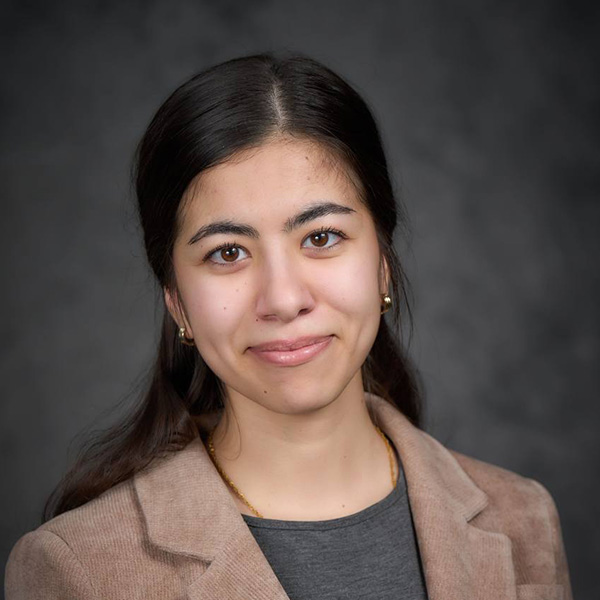
“It was kind of a transition,” Dilmurodova laughs, recalling the multilingual pivots that are not unusual for students in Central Asia—a cultural crossroads since the time of the Silk Road which currently includes the countries of Kazakhstan, Kyrgyzstan, Turkmenistan, Uzbekistan and Tajikistan. This diverse multilingual journey has enabled Dilmurodova to excel in domestic legal practice while confidently navigating international development work.
Now, Dilmurodova is studying international relations as a graduate student at Maxwell. Her presence here, and that of other students and scholars from her part of the world, reflects a broader trend that sees the region’s leaders using education to help build expertise and professionalism among civil servants, and it underscores the deep and growing ties between the Maxwell School and Central Asia.
In the fall of 2024, the Maxwell School hosted the Central Eurasian Studies Society’s conference, drawing more than 100 scholars from across the globe, including some from the Central Asian countries. And this summer, Maxwell Dean David M. Van Slyke and Dan Nelson ’04 M.P.A., director of accelerated learning and global engagement, visited Kazakhstan and Uzbekistan for a series of high-level government meetings and events.
They returned with significant insights from the region and signed memorandums of understanding (MOU) that will promote faculty and student exchanges, joint research and professional development programs.
“Our sustained and growing partnerships with Central Asia certainly expand the global impact of what we do at Maxwell,” said Van Slyke. “But more importantly, it shows the focus of many leaders in Central Asia on building the skills and knowledge among their citizens and public servants—current and future—that is going to unlock the potential for further economic development and success.”
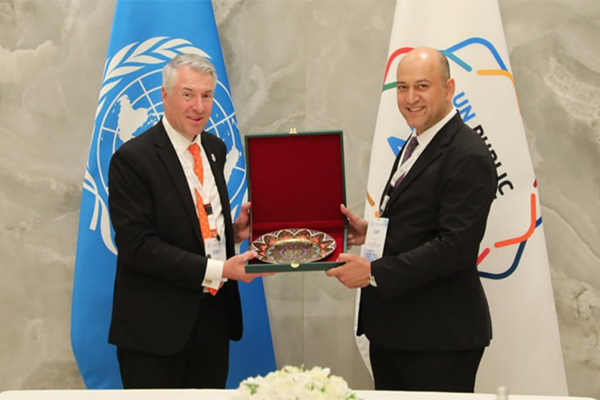
Van Slyke and Nelson began their visit in Astana, Kazakhstan, where they attended a forum on public service reform hosted by the Academy of Public Administration under the President of the Republic of Kazakhstan (APA). At the meetings, Van Slyke and Azamat Zholmanov, rector of APA, renewed their commitment to a partnership that has already seen scores of scholars and civil servants from Kazakhstan come through the halls of Maxwell. In addition, Van Slyke signed a promising new MOU with the Akimat of the city of Astana to expand this effort to educate those interested in public service.
One such civil servant is Assem Kurmanbayeva ’24 E.M.P.A., who works in public administration and financial management for the mayor’s office of Esil District of Astana. She participated in a Maxwell training program, earned an executive master of public administration from Maxwell and conducted research as a visiting executive scholar.
“My experience at Maxwell has been truly transformative,” says Kurmanbayeva. She says the Maxwell School “deepened my understanding of public service and gave me the tools to lead effectively in a fast-paced, high-responsibility environment. Today, in one of Astana’s most strategic districts, I apply what I learned at Maxwell every day—from navigating complex procurement processes to building partnerships that improve the quality of life for our residents.”
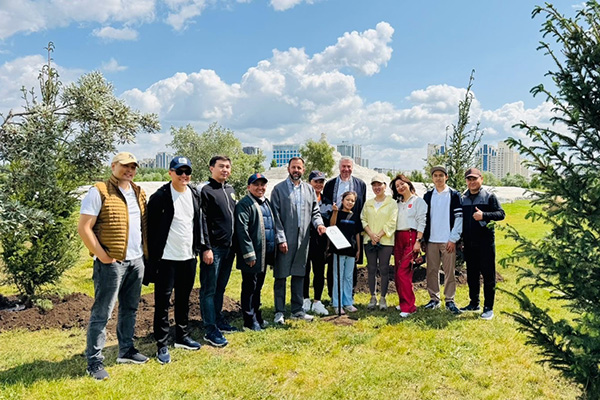
The dean’s visit to Kazakhstan also included a ceremony at the Astana Botanical Garden, where a delegation of officials and over a dozen Maxwell alumni planted trees and installed a sign recognizing the Maxwell School’s sustained efforts to help the nation achieve its public sector reform goals.
In Uzbekistan, Van Slyke and Nelson attended the United Nations Public Service Forum in Samarkand, one of the largest global events dedicated to the field of public administration. At the forum, he spoke on the institutional frameworks and policies that foster governmental reform. After meetings with the leadership of key agencies and institutions under the Administration of the President of the Republic of Uzbekistan, Van Slyke announced a new MOU, aimed at supporting capacity building goals of the government and make more educational journeys like Dilmurodova’s possible.
For Dilmurodova, the opportunity to study at Maxwell came thanks to Uzbekistan’s El-Yurt Umidi Foundation, a presidential initiative to cultivate skilled professionals for civil service development. Similar efforts across the region, including the Bolashak International Scholarship in Kazakhstan, demonstrate a commitment to invest in promising personnel who will support their country’s development.
While at Maxwell, she is focused on developing adaptable skills—negotiation, human resource management, leadership—that she can bring back to Uzbekistan.
“It's necessary to be flexible,” Dilmurodova adds, noting the pace of change in fields like artificial intelligence. “You have to learn quickly and adapt and integrate all the skills into your career.”
As Central Asian nations invest in modernizing governance and empowering future leaders, Maxwell’s partnerships are helping build a shared future rooted in public service excellence.
Dilmurodova concludes, “Sometimes innovation is not reinventing the wheel but adapting it.”
By Cort Ruddy
Published in the Fall 2025 issue of the Maxwell Perspective
Related News
School News
Oct 6, 2026
Media Coverage
Oct 5, 2026
School News
Oct 5, 2026
School News
Oct 1, 2026