Heartfelt Gift Recognizes Accomplished Alumna and Three Generations of Orange
August 21, 2025
William Pelton and Mary Jane Massie have created the Barringer Pelton Public Service Graduate Scholarship to honor their niece, Jody Barringer ’08 M.P.A., and support future public servants.
After working for a few years as an attorney focused mostly on environmental cases, Jody Barringer set her sights on a career pivot in hopes of influencing the law from within the public sector.
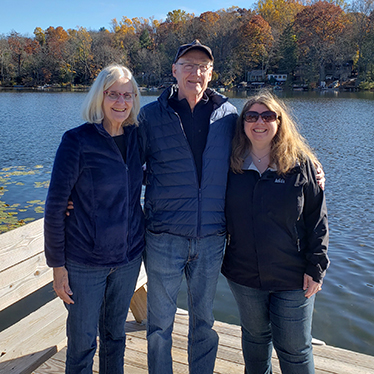
Knowing that a master of public administration (M.P.A.) would help in the transition, she turned to the Maxwell School. The nation’s top-ranked program had come highly recommended by friends who’d made similar changes, and it seemed a natural choice considering her roots: Barringer had already received two degrees from Syracuse University and represents her family’s third generation of proud orange alumni.
Barringer earned the M.P.A. in 2008 and launched a second career that quickly brought high-ranking roles in the federal government. She advised four presidents—Bush, Obama, Trump and Biden—and played an instrumental role in the multi-agency response to the 2010 Deepwater Horizon explosion and oil spill, the largest environmental disaster in U.S. history.
Through it all, Barringer found support from her proud uncle and aunt, William Pelton ’63, G’66 and Mary Jane Massie. “Uncle Bill,” as she calls him—among the family’s second-generation of Syracuse alumni—worked on groundbreaking technologies including GPS and laptop computers as a partner at the New York City patent law firm Cooper & Dunham before his retirement. He and Mary Jane encouraged their niece to follow her passion and provided financial support to supplement scholarships, grants and loans when she was an undergraduate.
Fast-forward to the present: To honor their niece and their family’s Syracuse legacy, Pelton and Massie recently have created the Barringer Pelton Public Service Graduate Scholarship at the Maxwell School. Their generous gift will provide financial support to graduate students interested in careers in local, state and federal government.
“I would not have gone to Syracuse without that little bit of money they chipped in to add to the financial aid package I was provided,” says Barringer. “Being able to give back to someone like me who might just be a little bit short or who needs an extra hand is so important because you never know what they can accomplish in the future. I am always so grateful to Bill and Mary Jane for supporting me in everything that I do.”
The scholarship is the latest philanthropic gift by Willam Pelton to support students at his beloved alma mater. His generosity has extended to the College of Law, where he received his degree in 1966, and to the College of Arts and Sciences (A&S), where he received a bachelor’s degree in physics in 1963.
Pelton’s gift to A&S in 2019 comes with still another Syracuse connection, as it honors the school’s longtime dean Eric Faigle. He graduated from the University with undergraduate and graduate degrees in 1928 and 1930, respectively. His wife, Lucy (Pelton) Faigle, a distant cousin of Pelton’s paternal grandmother, received a bachelor’s degree from Syracuse in 1924.
“Being able to give back to someone like me who might just be a little bit short or who needs an extra hand is so important because you never know what they can accomplish in the future.”
Jody Barringer ’08 M.P.A.
Faigle was in his ninth year as dean of the then-College of Liberal Arts when Pelton began his undergraduate studies. He says Faigle called him to his office one day and shared that he had been a mentor to Pelton’s father, Russell, who was a member of the University track team and 1935 alumnus.
Pelton’s sisters Marjorie Pelton and Marilyn Barringer ’69 also were Syracuse students. “As he did for me, Dean Faigle closely followed their academic careers through to graduation,” says Pelton. “He was always very generous with his time toward each of us. And believe me, we were grateful.”
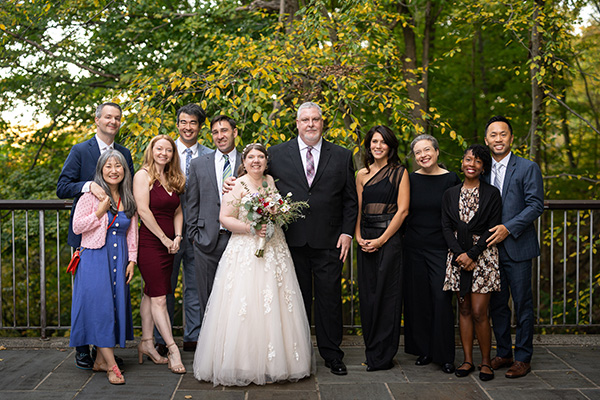
Pelton says the experiences of his niece, Jody Barringer, including the close friendships she found in the year-long M.P.A. program, inspired the latest gift. “She excelled in Maxwell and after she graduated, we met some of her classmates at her wedding, so I decided we should create a scholarship at Maxwell to recognize Jody,” he says.
Barringer knew she wanted to be a lawyer since she was about 13 years old, and says, “I had an amazing inspiration in my uncle.” After earning a bachelor’s degree from A&S in 1995 she attended the College of Law, where she earned numerous honors including Law Review editor and Phi Eta Sigma and Order of the Coif memberships. After receiving a juris doctor in 1998, she went to work for the Ford Marrin law firm in New York City, primarily handling environmental insurance cases. She was especially passionate about contamination suits that resulted in mitigation, cleanup and sometimes, reparations.
“Over time, I realized it would be a really interesting transition instead of working on the tail end of “who’s going to pay to clean it up?” to be on the side of making or influencing the policies to get people to be better actors in the environment to begin with,” she says.
Enter the Maxwell School. Barringer said her legal background was complemented by the skills and perspective she gained in the M.P.A. program. Training in budgeting, management and collaboration proved especially beneficial, she says, crediting professors like Peter Wilcoxen and David M. Van Slyke.
Wilcoxen’s economics course illustrated how preferences factor into economic trends—crucial knowledge for those on the front lines of policymaking. Van Slyke’s teachings on public-private partnerships and resource management likewise served her well, especially when she worked on complex responses such as Deepwater Horizon.
“Jody was an outstanding student who brought a passion for understanding and developing government-business relationships that could be mutually beneficial in which the public good can be realized,” says Van Slyke, dean and Louis A. Bantle Chair in Business-Government Policy. “I’m grateful for public servants like her that take initiative to break down barriers and open pathways for dialogue and cooperation.”
After Maxwell, Barringer worked for the U.S. Department of Energy briefly before joining the Office of Management and Budget (OMB) in the Executive Office of the President. There, she says, “You see things at a very high level, managing strategy as a whole.” She sat in on numerous high-level White House meetings. “You have to be a neutral advisor to the president, no matter who is the president,” she says, noting the shift in policy focus under each administration. “It’s fascinating, and actually very fun.”
Deepwater Horizon exploded in April 2010, four months after Barringer arrived at OMB. The catastrophe claimed 11 lives, injured 17 and poured 4.9 million barrels of oil into the Gulf of Mexico. “That was a very defining moment in my career,” she says. “My background in environmental litigation was crucial to handling that issue. Multiple agencies were involved in that response, and it went on for months.”
In her 14 years with OMB, Barringer led program management and resource allocation for hazardous waste cleanup and emergency response programs, advised on the development and implementation of environmental regulations and legislation, and mediated interagency disputes. In 2022, she moved to the Environmental Protection Agency as a senior executive in the Office of Resource Conservation and Recovery. She was responsible for developing and implementing regulatory standards, guidance documents and grant programs to promote proper waste management, recycling strategies and land cleanup.
Health issues brought an early retirement, in 2024, sooner than Barringer hoped. But she finds joy looking back on her many accomplishments, her family’s impactful legacy, and in knowing that her family’s gift will help support future generations of aspiring public servants.
“Public service has always been important to me,” she says. “We need good people to analyze, strategize and figure out what the best policy is to make things happen in a way that is easy on the public but also not so easy that it gets taken advantage of or that it ends up causing more problems than it’s worth. I want to make sure that the next generation of government workers have that same ability to analyze the way Maxwell teaches you how to analyze an issue.”
By Jessica Youngman
Published in the Fall 2025 issue of the Maxwell Perspective
Related News
School News

Oct 5, 2026
School News
Sep 24, 2026
School News

Sep 16, 2026