School News


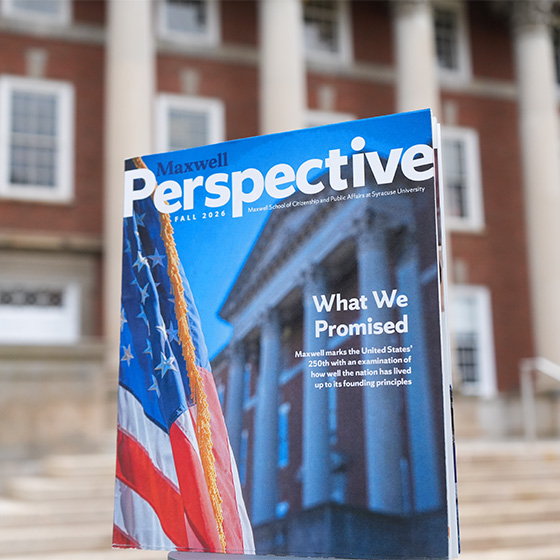
During the United States' 250th anniversary, Maxwell scholars are examining how well the nation has lived up to its founding principles.

Delali Kumavie, assistant professor of English in the College of Arts and Sciences, has been named the inaugural Autonomous Systems Policy Institute (ASPI) Fellow in the Arts and Humanities. The fellowship is primarily focused on providing the space and opportunity for faculty members in the humanities whose research intersects with the study of technology to develop their work, a potential syllabus and curate a conversation that focuses on their fields of study.
Kumavie studies the intersection of blackness, aviation and global transit by examining literary and cultural texts by Black writers and artists. She will further explore these intersections during her time as a faculty fellow by designing a course on myth and technology. This course will consider the ways in which technology draws on and is enfolded by conceptual codes that were developed in literary and cultural texts. Reading together critical theoretical conceptualizations of myth such as those by Roland Barthes, Northrop Frye, Hortense Spillers and Wole Soyinke with various ancient and contemporary mythologies, fiction and poetry the class will examine how a conceptual code of technology is accrued from literary texts.
In addition, Kumavie will curate a conversation on the topic of race and technology with invited speakers on blackness and technology. She will undertake preliminary work on two key collaborative projects, including one with Melissa Yuen at SU Art Museum
to develop a future exhibition on race, myth and technology.
Delali Kumavie, assistant professor of English in the College of Arts and Sciences, has been named the inaugural Autonomous Systems Policy Institute (ASPI) Fellow in the Arts and Humanities. The fellowship is primarily focused on providing the space and opportunity for faculty members in the humanities whose research intersects with the study of technology to develop their work, a potential syllabus and curate a conversation that focuses on their fields of study.
Kumavie studies the intersection of blackness, aviation and global transit by examining literary and cultural texts by Black writers and artists. She will further explore these intersections during her time as a faculty fellow by designing a course on myth and technology. This course will consider the ways in which technology draws on and is enfolded by conceptual codes that were developed in literary and cultural texts. Reading together critical theoretical conceptualizations of myth such as those by Roland Barthes, Northrop Frye, Hortense Spillers and Wole Soyinke with various ancient and contemporary mythologies, fiction and poetry the class will examine how a conceptual code of technology is accrued from literary texts.
In addition, Kumavie will curate a conversation on the topic of race and technology with invited speakers on blackness and technology. She will undertake preliminary work on two key collaborative projects, including one with Melissa Yuen at SU Art Museum
to develop a future exhibition on race, myth and technology.
Maxwell faculty and students engage in collaborative, cross-disciplinary research that achieves groundbreaking insights and analysis and provides a superior education for tomorrow’s effective leaders in their fields.
Delali Kumavie, assistant professor of English in the College of Arts and Sciences, has been named the inaugural Autonomous Systems Policy Institute (ASPI) Fellow in the Arts and Humanities. The fellowship is primarily focused on providing the space and opportunity for faculty members in the humanities whose research intersects with the study of technology to develop their work, a potential syllabus and curate a conversation that focuses on their fields of study.
Kumavie studies the intersection of blackness, aviation and global transit by examining literary and cultural texts by Black writers and artists. She will further explore these intersections during her time as a faculty fellow by designing a course on myth and technology. This course will consider the ways in which technology draws on and is enfolded by conceptual codes that were developed in literary and cultural texts. Reading together critical theoretical conceptualizations of myth such as those by Roland Barthes, Northrop Frye, Hortense Spillers and Wole Soyinke with various ancient and contemporary mythologies, fiction and poetry the class will examine how a conceptual code of technology is accrued from literary texts.
In addition, Kumavie will curate a conversation on the topic of race and technology with invited speakers on blackness and technology. She will undertake preliminary work on two key collaborative projects, including one with Melissa Yuen at SU Art Museum
to develop a future exhibition on race, myth and technology.
The Maxwell School is home to policy-relevant expertise across the social sciences. Our faculty are available to speak with the media about a wide range of issues, both domestic and international, including education, the environment, foreign affairs, immigration, public health, social welfare, tax policy and trade, among others.
Enjoy Maxwell Perspective magazine your way, both in print and online. Either way, you can expect the same great content accessible anytime: