Three Maxwell Professors Honored for Cross-University Collaboration
By Paige Schoen
November 3, 2026
The Central New York Humanities Corridor has recognized Timur Hammond, Mona Bhan and Azra Hromadžić for leading research groups on cities, conflict and the natural world.
Three Maxwell School professors are being recognized for building sustained research partnerships across university lines. The Central New York Humanities Corridor named Timur Hammond, Mona Bhan and Azra Hromadžić winners of its first-ever prize honoring the organizers of outstanding “working groups”—teams of scholars from different universities who meet regularly, often for years, to study a shared topic together.
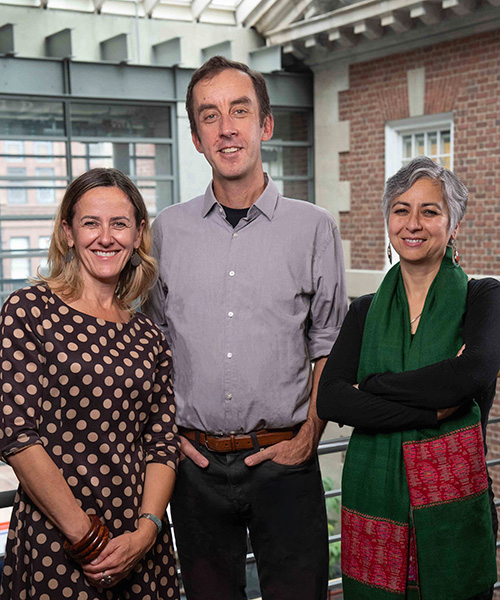
The prize, launched in 2025, recognizes groups for their sustained collaboration, mentorship across career stages and impact on scholarship and teaching. Founded in 2006 with a grant from the Mellon Foundation, the Central New York Humanities Corridor connects humanities scholars at 11 colleges and universities, including Syracuse, Cornell and the University of Rochester, funding joint research, teaching and public programming that would be difficult for any single campus to support alone.
Hammond, associate professor and director of graduate studies for Maxwell’s Geography and the Environment Department, helps lead Urban Natures, a group now in its fourth year that brings together scholars from Syracuse, Cornell and the Rochester Institute of Technology to study how architecture, art and everyday life bring nature into cities—and how cities, in turn, reshape the natural world. The corridor praised the group for mentoring scholars across career stages and extending that community beyond campus; one partnership, with a New York-based ornithologist, has already shaped plans for future research. Hammond’s work traces how cities, memory and religion intersect, largely through his research on Istanbul. He is a senior research associate and faculty advisory committee member with the Middle Eastern Studies Program, and a research affiliate with the South Asia Center and the Center for European Studies.
Bhan and Hromadžić lead War Ecologies, a group now in its fourth year that studies how war reshapes the natural world—the land, water and ecosystems of places like Kashmir, Bosnia and Rwanda. In that time, the group’s members have produced three books, four articles and several grants, work the corridor linked partly to the group’s annual writing retreats, now a tradition among its members.
Bhan, a professor of anthropology and the Ford-Maxwell Professor of South Asian Studies, explores the intersections between militarization, settler colonialism, counterinsurgency and climate change. She directs Maxwell’s South Asia Center.
Hromadžić, a professor and undergraduate director in the Anthropology Department, studies ethno-political violence and post-conflict reconciliation; youth cultural practices; environmental politics and riverine worlds. She is a Laura J. and L. Douglas Meredith Professor for Teaching Excellence and a senior research associate with the Program for the Advancement of Research on Conflict and Collaboration.
“These partnerships extend Maxwell’s reach well past Syracuse," said Shana Kushner Gadarian, associate dean for research and professor of political science. “Timur, Mona and Azra are bringing ideas and collaborators from across the region back into their classrooms and research, and that benefits our students directly—they get exposure to a wider scholarly community than any one university could offer on its own.”
Related News
Research
Oct 28, 2026
Research
Oct 26, 2026
Media Coverage

Oct 20, 2026