Maxwell School News and Commentary
Filtered by: Foreign Policy
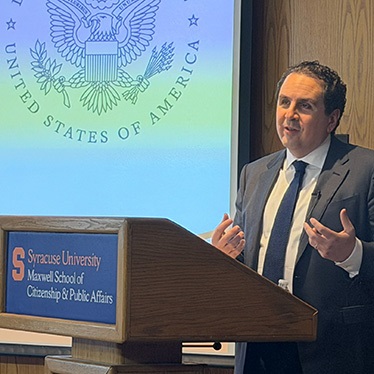
Pete Buttigieg Driven by ‘Propulsion’—Not ‘Despondency’
The former U.S. Secretary of Transportation joined Professor Jay Golden for a capacity event that covered environmental issues, leadership, democracy and more.
McDowell Piece on the Trump Administration and Global Currency Published by Atlantic Council
"In the great global currency debate, market forces have never been more passé and political forces have never been so prominent," writes Maxwell Advisory Board Professor of International Affairs Daniel McDowell.
See related: Economic Policy, Federal, International Affairs, U.S. Foreign Policy, United States
Taylor Weighs In on the Presidential Summit Between Russa and the US in Los Angeles Times Article
“This will be the first U.S.-Russia summit brought about by sheer ignorance and incompetence: The U.S. president and his chosen envoy mistook a Russian demand for a concession,” says Brian Taylor, professor of political science and director of the Moynihan Institute of Global Affairs.
See related: Conflict, Federal, Foreign Policy, International Affairs, Russia, Ukraine, United States
Taylor Weighs In on Trump’s Approach to Aiding Ukraine in Newsweek Article
“The good news for Ukraine is that...Trump has finally figured out that Putin is the main obstacle to peace,” says Brian Taylor, director of the Moynihan Institute of Global Affairs.
See related: Federal, International Affairs, U.S. Foreign Policy, Ukraine, United States
Offen Quoted in Politico Article on Trump’s Obsession With Maps
It’s a political tactic that has lasted as long as maps have, according to Karl Offen, professor of geography and the environment. “Maps and politics have been wedded from day one,” Offen says. “To name is to claim.”
See related: Federal, Foreign Policy, International Affairs, Maps, United States
Taylor Speaks With CBS News, El País, KTVU and Kyiv Post About Trump, Ukraine and Russia
“Putin isn’t interested in a ceasefire or an agreement, but rather in victory, understood as the subjugation of Ukraine,” says Brian Taylor, professor of political science. “The Russian president has faced zero consequences for stalling Trump over the past four months, and from what Trump has said about the conversation, that hasn’t changed one bit.”
See related: Conflict, Europe, Federal, Foreign Policy, Global Governance, International Affairs, Russia, Ukraine, United States
Khalil Speaks With Clarín About Trump’s Meeting With the President of Syria
The meeting between Trump and al-Sharaa “represents a remarkable shift in U.S. policy toward al-Qaeda and its affiliates. More than 23 years after the 9/11 attacks and the declaration of the Global War on Terror, the United States is developing relations with a former leader of the organization who now declares himself a moderate,” says Osamah Khalil, professor of history.
Taylor Speaks With WWL Radio About US-Russia Relations
“There have been a variety of efforts since the Soviet Union collapsed in 1991 to try and remake the U.S.-Russia relationship...Obviously a lot has happened since then and it hasn't worked out that way and from my point of view, the thing that has broken the relationship most of all has been the Russian war against Ukraine which began in 2014,” says Brian Taylor, professor of political science.
See related: Conflict, Federal, International Affairs, Russia, U.S. Foreign Policy, Ukraine, United States
Reeher Talks to CBS New York and WCNY About President Trump’s First 100 Days
“Donald Trump has come in and has had just a blizzard of executive orders and other kinds of actions that have had serious impact in the federal government, the relations between the major branches of government and have had effects that have trickled down into Syracuse,” says Grant Reeher, professor of political science.
See related: Congress, Economic Policy, Federal, Tariffs, U.S. Foreign Policy, U.S. Immigration, United States
Can Studying in the US Survive Geopolitics? Yingyi Ma Discusses in Brookings Institution Article
“What’s at risk is not just enrollment numbers or university budgets—it’s the future of American innovation and the country’s standing in the world,” says Yingyi Ma, professor of sociology.
See related: China, Education, International Affairs, U.S. Foreign Policy, U.S. Immigration, United States