Taming the Careerists: The Politics of Foreign Policy Implementation
Minju Kim
Cambridge University Press, July 2026
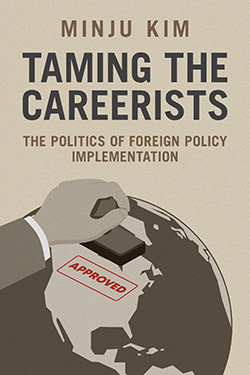
Minju Kim, assistant professor of political science, has written Taming the Careerists: The Politics of Foreign Policy Implementation (Cambridge University Press, 2026).
More than two million bureaucrats serve in the U.S. federal government under various employment contracts. The book asks how the design of those contracts, specifically, the features that strengthen or weaken job protections, shapes bureaucratic behavior and, in turn, American foreign policy. Kim demonstrates that presidents can influence bureaucrats not only through direct oversight tools but also by weakening job protections, making bureaucrats more responsive to presidential preferences. She finds, however, that loosening those protections can have an unintended cost: disrupting the stability of foreign economic policy.
Drawing on administrative data, policy memos, interviews and computational text analysis, the book reveals the trade-off between accountability and stability in the personnel management rules that quietly sustain the daily work of America’s foreign policy bureaucracy.
Kim is a research affiliate of the East Asia Program at the Maxwell School’s Moynihan Institute of Global Affairs. Her research focuses on international political economy, bureaucratic politics and international trade. Her work has appeared in International Studies Quarterly, Review of International Organizations and World Politics. She received the 2025-26 Laura J. and L. Douglas Meredith Teaching Recognition Award for Early Career Performance from Syracuse University.
From the publisher:
Over two million bureaucrats serve in the US federal government under various employment contracts. Minju Kim's Taming the Careerists asks how the design of those contracts—specifically, the features that strengthen or weaken job protections—shapes the behavior of bureaucrats and, in turn, American foreign policy. While past studies identify tools that help the president control the bureaucracy, Kim demonstrates that the president can additionally control the behavior of bureaucrats by weakening job protections, which makes bureaucrats more accountable to presidential preferences. The book shows that bureaucrats adjust how they implement policy based on the structure of their job protections, and that weakening these protections can unintentionally disrupt the stability of foreign economic policy. Drawing on administrative data, policy memos, interviews, and computational text analysis, Kim reveals the trade-off between accountability and stability, shedding light on the personnel management rules that quietly sustain the daily work of America's foreign policy bureaucracy.
Related News
School News

Oct 7, 2026
Media Coverage

Oct 6, 2026
Media Coverage

Oct 5, 2026