Understanding International Security: Theory and Practice
Michael John Williams, James Wesley Hutto, Asli Peker Dogra
Cambridge University Press, October 2025
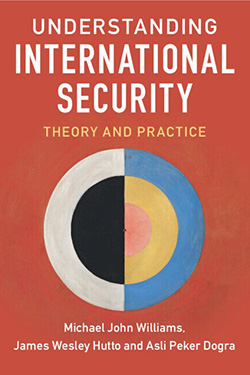
Michael Williams, associate professor of public administration and international affairs, has co-authored a new book, Understanding International Security: Theory and Practice (Cambridge University Press, 2025).
The book explores the meanings and debates around international security, with chapters addressing war, terrorism, violence, cyber security, health and more. Williams and co-authors Wes Hutto of the School of Advanced Air and Space Studies and Asli Peker Dogra of New York University examine theories in depth and discuss how they work in practice. Through scholarly and policy examples, they chart developments in global security over time and in context. Understanding International Security: Theory and Practice also uses maps, discussion questions and other illustrations to help promote understanding and learning.
Williams is the director of international relations graduate programs and the International Affairs Seminar Series from the Moynihan Institute of Global Affairs. He is an associate professor of political science by courtesy appointment and a senior research associate in the Center for European Studies. He specializes in the contemporary Atlantic world, the Cold War, foreign policy and international security. He has authored three books and serves as editor-in-chief of International Politics.
He has been a NATO Security Studies Fulbright Fellow at the Brussels School of Governance in Belgium, a Robert Bosch Fellow in the German Ministry of Defense, a visiting fellow at the University of Oxford’s Rothermere American Institute and a DAAD Fellow at the Bundeswehr Center for Social Science in Potsdam.
From the publisher:
“International security is an ambiguous concept – it has many meanings to many people. Without an idea of how the world works, or how security is defined and achieved, it is impossible to create effective policies to provide security. This textbook clarifies the concept of security, the debates around it, how it is defined, and how it is pursued. Tracking scholarly approaches within security studies against empirical developments in international affairs, historical and contemporary security issues are examined through various theoretical and conceptual models.”
Published in the Fall 2025 issue of the Maxwell Perspective
Related News
Media Coverage

Oct 16, 2026

Media Coverage

Oct 14, 2026