Wanting Children: Family-Planning Policies and the Engineering of America’s Population
Leonard M. Lopoo
University of Chicago Press, June 2026
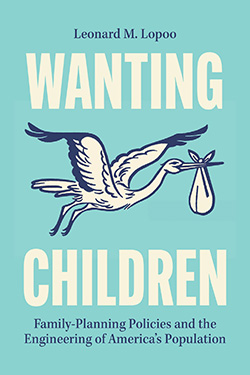
Leonard M. Lopoo, professor, chair and associate dean of public administration and international affairs, has written Wanting Children: Family-Planning Policies and the Engineering of America’s Population (University of Chicago Press, 2026).
The book traces how America’s first reproductive policies were shaped by eugenicists focused on limiting births among lower-income and minority populations. This origin has left the United States in a contradictory position, subsidizing contraception for its poorest citizens while other wealthy nations support a wider range of fertility interventions.
He argues that equity must be the guiding principle, saying that if the government is going to influence reproduction, it must help people who want children to have them.
Lopoo is the Paul Volcker Chair in Behavioral Economics, director and co-founder of the Maxwell X Lab, a senior research associate in the Center for Policy Research and a research affiliate in the Lerner Center for Public Health Promotion and Population Health.
His research has been published in journals including Demography, The Journal of Human Resources and the Journal of Policy Analysis and Management. He has received funding from federal agencies and foundations including the Pew Charitable Trusts, the National Institute on Aging and the United States Department of Agriculture.
Lopoo joined Syracuse University in 2003. His research focuses on family policy, demography and behavioral public policy.
From the publisher:
The U.S. government spends hundreds of millions of dollars every year to promote and facilitate contraception. Whereas other wealthy countries support broader fertility interventions under the banner of "family planning," the United States remains committed only to helping Americans — and especially poorer Americans — plan not to have a family. In an unflinching treatise on one of the century's defining social issues, Leonard M. Lopoo shows how the US's asymmetric reproductive approach is a vestige of the country's earlier sins: America's first reproductive policies were authored by some of the twentieth century's most prominent eugenicists, a group whose primary goal was birth prevention among lower economic classes and racial minorities. Wanting Children posits a new and elevating criterion for how we think about fertility in the twenty-first century.
Related News
School News

Oct 9, 2026
Research

Oct 8, 2026
Research

Oct 6, 2026