Maxwell Students Research Impact of Redlining as 2024-26 Lender Fellows
November 14, 2025
Related:
Citizenship & Civic Engagement Undergraduate Program
Tommy DaSilva, Darla Hobbs, Jamea Candy Johnson and Sabrina Lussier are exploring housing as a critical determinant of social and health inequities under the guidance of Miriam Mutambudzi.
While an undergraduate in the College of Arts and Sciences, Jamea Candy Johnson ’25 served as a congressional intern—a role that included legislative research, policy development and constituent service.
She also took first place in the 2023 Blackstone LaunchPad Small Business Pitch Contest for an organization she founded, Black Girls Garden, that teaches young Black girls and women in low-income living situations to grow their own food to combat food insecurity and poor nutrition.
Now pursuing a master in public health (MPH), Johnson brings her experience in public service and entrepreneurship and a passion for community empowerment to her work as a student fellow for the University’s Lender Center for Social Justice.
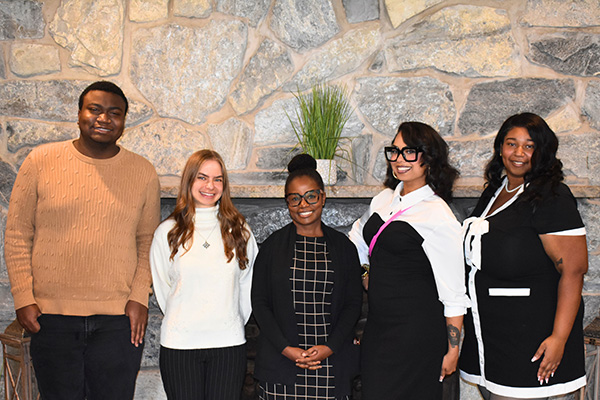
Johnson is one of four Maxwell students in the five-member 2024-26 Lender fellow cohort. Alongside Tommy DaSilva, Darla Hobbs and Sabrina Lussier, she is researching the historical and ongoing impacts of redlining and housing segregation under the guidance of Miriam Mutambudzi, associate professor of public health, faculty associate in the Aging Studies Institute and the 2024-26 Lender Center faculty fellow.
The Lender Center supports students and faculty who work collaboratively to identify and address pressing social issues. In examining the housing challenges that disproportionately affect historically redlined and marginalized neighborhoods, the cohort is exploring how residents experience ongoing health consequences, occupational disadvantages, displacement pressures, barriers to safety and access, and other interconnected impacts across Syracuse’s evolving housing landscape.
Their research is directly supporting and helping to shape the Thursday morning community roundtable conversations organized through a partnership between the Syracuse University Community Engagement Office and the Lender Center for Social Justice. The roundtables bring together residents, policymakers and nonprofit leaders to examine how systemic inequities in housing, community safety and other areas continue to influence employment, income stability and chronic health conditions in historically marginalized neighborhoods.
“This fellowship has shifted my perspective on a lot,” Johnson said. “The research that we do really opens your eyes to a lot of what the true nature of things are, and not the kind of idea that you've been sold on about how positive certain things are.”
Last semester, their research looked at how housing affects employment and chronic health outcomes across the country. This national perspective is helping them better understand the local housing issues they are now studying, especially the long-term socioeconomic and health effects of housing inequities. The fellowship allows each student to tailor the research to what they are personally passionate about, as each of the Maxwell fellows brings a different academic lens to the project.
“Our fellows are not just studying these issues, they are engaging with the community, listening, learning and helping to shape conversations that matter for Syracuse’s future,” said Mutambudzi. “Working on this project has shown us how deeply housing conditions shape people’s daily lives. Listening to residents and community partners helps us understand the real issues beyond data and pushes us to think about solutions that truly reflect their experiences.”
DaSilva, a senior, is majoring in public health, policy studies and citizenship and civic engagement. He has spent the fall 2025 semester in Washington, D.C., gaining perspective and insight on how decisions are made at the highest level.
DaSilva has been involved in the Student Association of Public Health Education and Connect 315. He has interned with the YWCA of Syracuse and ACR Health and worked for Syracuse’s Department of Neighborhood and Business Development. He said the fellowship has connected his interests and deepened his understanding of different approaches to equity.
“The real focus of this fellowship has been engaging with community members and stakeholders, and that's where CCE has really been able to slot in,” DaSilva said. “It's allowed me to both work in an area I'm passionate about and work with other people who are passionate about the same things.”
Lussier, a senior, also has three majors: geography; environment, sustainability and policy; and citizenship and civic engagement. She approaches housing inequity through the lens of urban planning and sustainability. She is an honors student, a Maxwell Leadership Scholar, a STOP Bias peer educator, a resident advisor for the MORE in Leadership Living Learning Community, and worked for the Syracuse Neighborhood and Business Development Office during her sophomore year.
Lussier’s honors thesis explores how freeway demolition and urban redevelopment affect marginalized communities—specifically Syracuse’s 15th Ward and I-81 corridor.
“Being an outsider, coming from the suburbs of D.C. and not being a part of the communities that I'm trying to support, I am learning to listen above all else to what people are saying,” Lussier said.
Hobbs is pursuing a public management and policy certificate of advanced study. A graduate student in Pan African studies in the College of Arts and Sciences, she majored in communication and rhetorical studies as an undergraduate in the College of Visual and Performing Arts. She grew up in Syracuse’s Westside and has felt and observed the impact of redlining which displaced nearly a thousand families, many of whom were from the 15th Ward which housed about 90% of Syracuse’s Black population.
Hobbs brings her experience and passion for her hometown to Lender research. She has analyzed census and population data to determine how historical redlining still affects public health outcomes and employment trajectories.
“What can I do to anchor everything that I've learned about the Black experience and the different kinds of systemic oppression? What can we do to make a change?” Hobbs said. “Maxwell provided me with that opportunity.”
The fifth Lender fellow, Shreya Potluri, is an architecture major in the School of Architecture.
“The fellowship teaches a lot about teamwork and discussing the feasibility of how different policies work,” Johnson said. “We can propose the idea any day of the week, but how likely is it to get done? It forces us to think outside of the box and put a lot of what we learn in class into practical applications.”
By Mikayla Melo
Published in the Fall 2025 issue of the Maxwell Perspective
The Lender Center for Social Justice
The Lender Center for Social Justice is a University center promoting multidisciplinary and dynamic collaborations that support the development of courageous and ethical scholars and citizens who are committed to practices of social justice. It is housed in the Office of Academic Affairs and aspires to foster proactive, innovative and interdisciplinary approaches to issues related to social justice, equity and inclusion. For more, visit the Lender Center website.
Related News
Research
Oct 7, 2026
Research
Oct 6, 2026
Media Coverage
Oct 6, 2026