Ambiguous Inclusion: Migration and Race on the Russia-China Border
Lauren Woodard
University of Toronto Press, April 2026
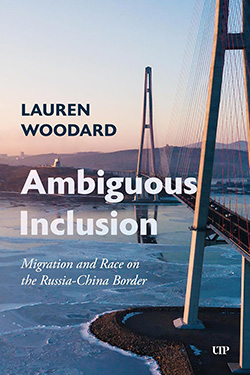
Lauren Woodard, assistant professor of anthropology, has written Ambiguous Inclusion: Migration and Race on the Russia-China Border (University of Toronto Press, 2026).
The book draws on 17 months of ethnographic fieldwork in Moscow and Vladivostok, Russia, and Almaty, Kazakhstan. It examines how Russian citizenship policies shape identity and belonging for migrants in the country’s Far East—a region at the crossroads of the Russia-China border—and how the state’s efforts to attract and incorporate newcomers are bound up with deeper, contested questions about national identity at a moment of rising nationalism worldwide.
At the center of the book is Russia’s Resettlement of Compatriots Program, which offers expedited citizenship and state benefits to Russian-speaking migrants from former Soviet countries. Woodard finds that many who immigrate through the program still struggle to feel at home; their unease reflecting racial hierarchies shaped by complex ideas about ethnicity, language and culture that official policy does not fully account for.
The book received the spring 2025 First Book Subvention from the Association for Slavic, East European, and Eurasian Studies. Woodard’s research has also been supported by the Wenner-Gren Dissertation Fellowship, Fulbright research grants to Russia and Kazakhstan, and the Social Science Research Council. She was awarded the Title VIII Research Scholar fellowship by the Wilson Center in 2022.
Woodard earned a doctorate in anthropology from the University of Massachusetts Amherst in 2019.
From the publisher:
Ambiguous Inclusion examines how migrants and state officials in Primorskii krai – Russia’s Far Eastern border with China and North Korea – draw on legacies of inclusion as migrants apply for Russian citizenship.
Though many migrants from post-Soviet states obtain expedited citizenship due to shared language and Soviet ties, they often face exclusion in their everyday lives in Russia. Through ethnographic accounts, this book explores how Soviet ideals of internationalism and modern-day nationalism clash in everyday encounters between migrants and bureaucrats. Russia’s citizenship policies frame inclusion around Russian language and multiethnic unity, yet in practice often reinforce hierarchies linked to ethnicity and whiteness, even as race remains officially unacknowledged. Drawing on anthropologist Lauren Woodard’s 17 months of fieldwork, Ambiguous Inclusion reveals how officials reproduce xenophobia, even when they do not intend to, by transforming migrants into ‘compatriots.’
By tracing how inclusion is both granted and withheld, this book shows how inclusion and belonging operate alongside exclusion and discrimination in post-imperial contexts. It challenges conventional views of nation-states and migration, offering insights into the ways in which race, identity, and citizenship are negotiated in contemporary Russia.
Related News
Research
Oct 7, 2026
Research
Sep 25, 2026
Media Coverage
Sep 1, 2026