Judging Through Narrative: Muslim Family Laws in Non-Muslim Courts
Yüksel Sezgin
Cambridge University Press, July 2026
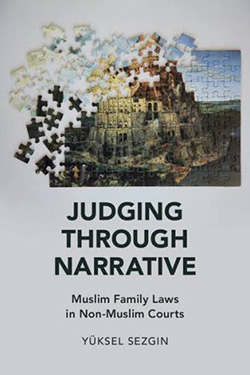
Yüksel Sezgin, professor of political science, has written Judging Through Narrative: Muslim Family Laws in Non-Muslim Courts (Cambridge University Press, 2026).
The book examines the narratives non-Muslim courts construct when Muslim family law disputes come before them, and what those narratives mean for the rule of law, gender reform and public trust in the justice system. Sezgin draws on more than 400 interviews with judges, lawyers and litigants and an analysis of nearly 3,000 judicial decisions from Ghana, India, Israel and Greece. He finds that the coherence or fragmentation of judges’ storytelling influences both legal legitimacy and the prospects for reform. Central to the book is a new concept, “narratival (in)cohesion,” which offers a framework for understanding how courts mediate between religion, rights and state authority. Bridging law, political science and socio-legal studies, it is aimed at scholars, policymakers and practitioners who want to understand how judicial narratives shape the lived experience of law in diverse, multi-religious societies.
Sezgin directs the Law, Society and Policy program and the Pre-Law Program in Europe and is an O’Hanley Faculty Scholar. He is a senior research associate in the Middle Eastern Studies Program and a research affiliate of the South Asia Center, both part of the Maxwell School’s Moynihan Institute of Global Affairs. He is also a professor by courtesy appointment in the College of Law. His research examines legal pluralism, courts and judicial decision-making, and law and narrative, drawing on fieldwork in the Middle East, South Asia and Sub-Saharan Africa. His scholarship also increasingly explores the role of artificial intelligence in judicial decision-making. He is also the author of award-winning Human Rights under State-Enforced Religious Family Laws in Israel, Egypt and India (Cambridge University Press, 2013).
From the publisher: Judging Through Narrative explores the normative frames, or judicial narratives, that non-Muslim courts construct when adjudicating Muslim Family Law disputes. The book examines how these narratives shape the rule of law, gender reform, and public trust in the justice system. Drawing on over 400 interviews with judges, lawyers, and litigants, and an analysis of nearly 3,000 judicial decisions from Ghana, India, Israel, and Greece, the book reveals how coherence and fragmentation in judicial storytelling influence legal legitimacy and reform. Introducing the concept of “narratival (in)cohesion,” this work offers a new framework for understanding how courts mediate between religion, rights, and state authority. Bridging law, political science, and socio-legal studies, it is an essential resource for scholars, policymakers, and practitioners seeking to understand how judicial narratives shape the lived experience of law in diverse, multi-religious societies.
Related News
Media Coverage

Oct 26, 2026
Research

Oct 19, 2026

Media Coverage

Sep 17, 2026