The Archaeology of Hassanamesit Woods:The Sarah Burnee/Sarah Boston Farmstead
Heather Law Pezzarossi
BAR Publishing, December 2024
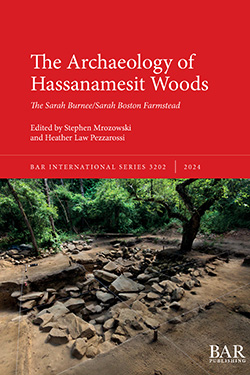
Heather Law Pezzarossi, assistant professor of anthropology, has co-edited and contributed to a new book, The Archaeology of Hassanamesit Woods:The Sarah Burnee/Sarah Boston Farmstead (BAR Publishing, 2024).
The book explores the Sarah Burnee/Sara Boston Farmstead, a household in the Nipmuc community of Hassanamesit, and its excavation. Using archaeological data, material culture, documentary and oral histories, its authors illustrate Nipmuc women’s lives during the 18th and 19th centuries. They discuss the collaboration between the Hassanamisco Nipmuc and the Fiske Center for Archaeological Research at the University of Massachusetts, Boston, and analyze the political and economic qualities of an indigenous household.
Law Pezzarossi authored the book’s second chapter on Hassanamesit history and co-wrote several additional chapters. She is an anthropologically trained archaeologist whose research focuses on collaborative work with Indigenous communities in North America. She has worked with the Hassanamisco Nipmuc Community in southern New England for over 10 years and is a co-organizer of the Listen to the Elders speakers series, a program that spotlights elders from Haudenosaunee Nations to share teachings to the Syracuse community. She has co-edited and co-written several books, including Historical Archaeology and Indigenous Collaboration: Discovering Histories That Have Futures (University Press of Florida, 2020), which was awarded the Society for American Archaeology’s Scholarly Book Prize in 2021.
From the publisher:
“This monograph provides a comprehensive overview of the excavations of the Sarah Burnee/Sara Boston Farmstead, a multigenerational, female-headed household in the Nipmuc community of Hassanamesit. It outlines the organic quality of an evolving collaboration between the Hassanamisco Nipmuc of what is today Grafton, Massachusetts and the Fiske Center for Archaeological Research at the University of Massachusetts, Boston. The report details the collaboration as well as the excavation and analysis of an indigenous household that was economically and politically active during the 18th and 19th Centuries. Drawing on a rich corpus of archaeological data including micromorphology, material culture, floral and faunal analysis as well as documentary and oral histories, this monograph provides a rich portrait of Nipmuc women’s lives that continues to inspire their Hassanamisco descendants today. It serves as a model of how collaboration can reawaken Nipmuc pasts, and the links to Nipmuc futures.”
Published in the Fall 2025 issue of the Maxwell Perspective
Related News
Research
Oct 12, 2026
Media Coverage

Oct 12, 2026
School News
Oct 9, 2026