The Last Door: A History of Torture in Mexico's War against Subversives
Gladys McCormick
University of California Press, May 2025
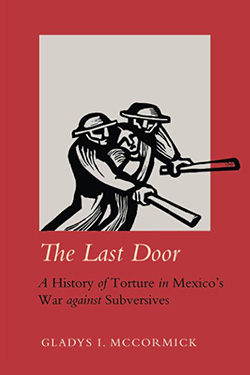
Gladys McCormick, associate dean and professor of history, has written a new book, The Last Door: A History of Torture in Mexico's War against Subversives (University of California Press, 2025).
The book explores how the Mexican government increasingly used torture to suppress dissent as guerrilla movements spread across Mexico in the 1970s. McCormick examines how torture became central to state policy, drawing on interviews and declassified documents to detail widespread abuses, including forced disappearances.
Rather than just extracting information, torture served to punish perceived enemies and intimidate those seeking social change, McCormick contends. This normalized violence fostered lasting trauma and helped entrench a culture of impunity that still shapes Mexico’s current security challenges.
McCormick is the Jay and Debe Moskowitz Endowed Chair in Mexico-U.S. Relations and a senior research associate for the Program for the Advancement of Research on Conflict and Collaboration. She is also an advisory board member and senior research associate for the Program on Latin America and the Caribbean. Her research focuses on the political and economic history of Latin America and the Caribbean and political violence. She has received several awards from Syracuse University, including the Daniel Patrick Moynihan Award for Teaching and Research in 2017, and the Laura J. and L. Douglas Meredith Teaching Recognition Award.
From the publisher:
As guerrilla groups sprouted up across Mexico in the early 1970s, the military and police routinely resorted to extreme acts of violence, including the systematic use of torture. In The Last Door, Gladys McCormick provides the most thorough account of how torture became a crucial and routine practice of the Mexican government’s war against subversives. Drawing from extensive oral history interviews and declassified government documents, McCormick describes experiences of arrest, torture, and detention in which forced disappearances became all too common and advocates for justice rallied around political prisoners. Torture was not always about extracting information; it was also about inflicting punishment on a faceless so-called enemy and instilling terror into advocates of social change. As McCormick argues, torture became a quotidian practice of state making in Mexico during the 1970s, leaving individuals and their families forever changed. The lack of repercussions for government officials notorious for employing torture, even in spite of a growing movement for truth and justice, has led to entrenched impunity that is endemic in Mexico as its contemporary security crisis continues.
Published in the Fall 2025 issue of the Maxwell Perspective
Related News
Research

Oct 12, 2026
Media Coverage

Oct 12, 2026
School News

Oct 9, 2026