Featured Research
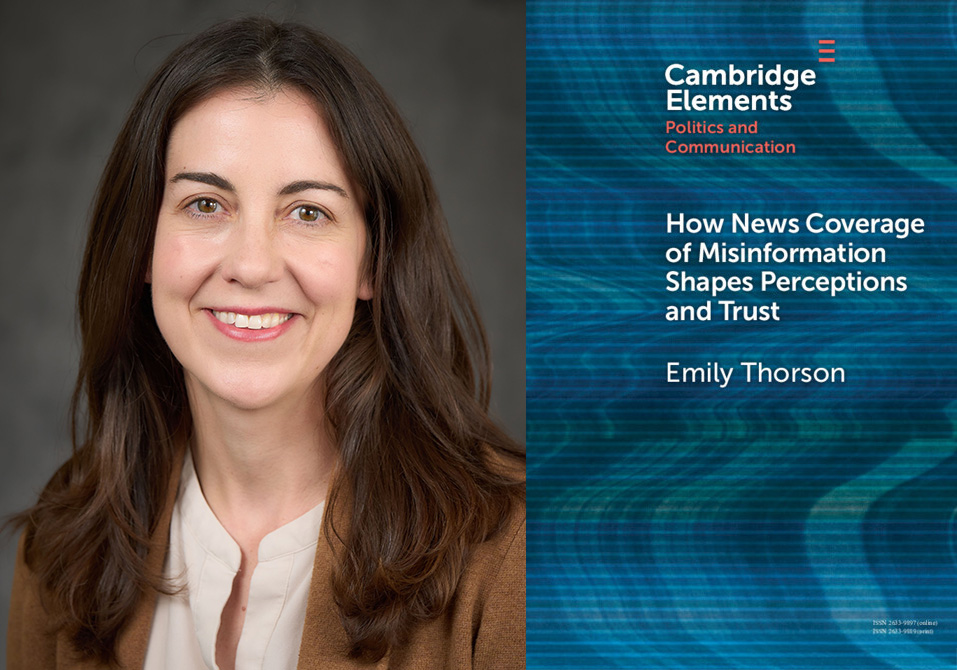
Emily Thorson, associate professor of political science and senior research associate in the Campbell Public Affairs Institute, analyzes how the media addresses the issue of misinformation and how such coverage shapes public perception and trust. It explores the relationship between news and social media, highlighting how mainstream media often places blame on social media for the spread of false information.
Cambridge University Press, 2024
“It's Not the Economy: The Effect of Framing Arguments on Attitudes Toward Refugees”
In this article, Lamis Abdelaaty, associate professor of political science, and her co-authors assess whether and how economic, legal, and moral arguments affect Americans’ support for refugee admissions, and which types of refugees they prefer to admit.
International Migration Review, 2025
“Analyzing the Stability of Gun Violence Patterns During the COVID-19 Pandemic in Syracuse, New York”
Professors Robert A. Rubinstein, Sandra D. Lane and their co-authors investigate whether COVID-19 altered the geospatial patterns of gun violence in Syracuse, New York.
International Journal of Health Geographics, 2025
Doing Fieldwork: The Correspondence of Robert Redfield and Sol Tax, Revised Edition
Robert A. Rubinstein
Routledge, December 2001
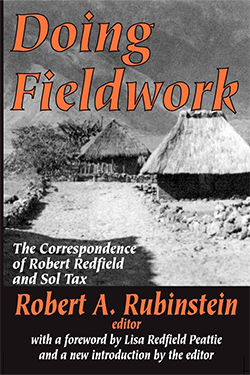
Prior to the 1930s the highlands of Guatemala were largely undescribed, except in travelogues. Just two decades later, the highlands had become one of the most anthropologically well-investigated areas of the world. This is largely due to the research that Robert Redfield and Sol Tax carried out between 1934 and 1941.
Separately and together, Redfield and Tax anticipated and guided anthropological investigations of people living in peasant and urban communities in other areas of the world. Their work helped to define the major outlines of research in the 1970s, and since then much writing about the region has been formulated in critical response to the Redfield-Tax program. Not coincidentally, since the mid-1970s anthropology has been caught up in a wave of self-doubt about the status of fieldwork and the authority of ethnographic description. This critical stance has often cast ethnography as a creative, literary enterprise.
This volume presents a timely view of the process of ethnography as carried out by two of its early practitioners. Containing a wealth of ethnographic detail, the book reveals how Redfield and Tax developed and tested ethnological hypotheses, and it allows us to follow the development of their major theoretical statements. The result is an exceptionally clear picture of the process of ethnography. Redfield and Tax emerge as rigorous and sensitive observers of social life whose observations bear importantly on contemporary understandings of the ethnology of Guatemala and the enterprise of anthropology. This book will be of interest to students of method and theory in ethnography, Latin Americanists, and other professionals interested in the history of idea.

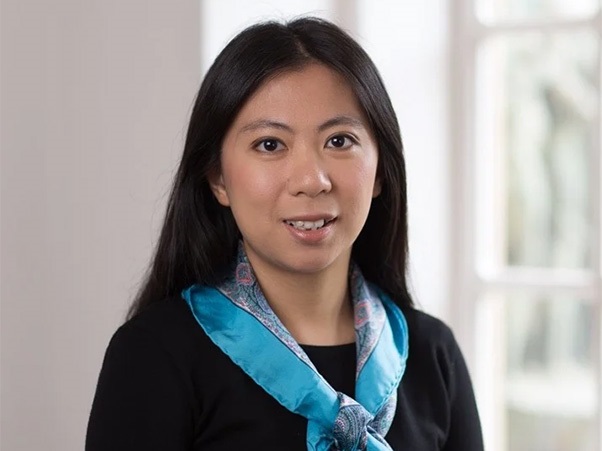
Baobao Zhang has received up to $200K to research the role of citizens in the governance of artificial intelligence systems.
Lecture Series
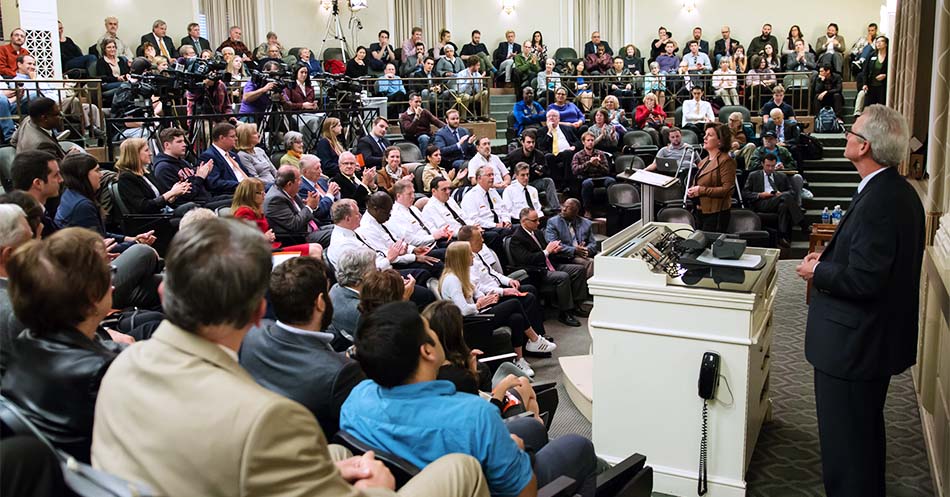
Campbell's lecture series bring together people with a diverse range of perspectives and interests to open dialogue, foster understanding and give the power of knowledge.
Bantle Symposium on Business and Government Policy
Phanstiel Lecture Series on Leadership
State of Democracy Lecture Series
Tanner Lecture Series on Ethics, Citizenship and Public Responsibility
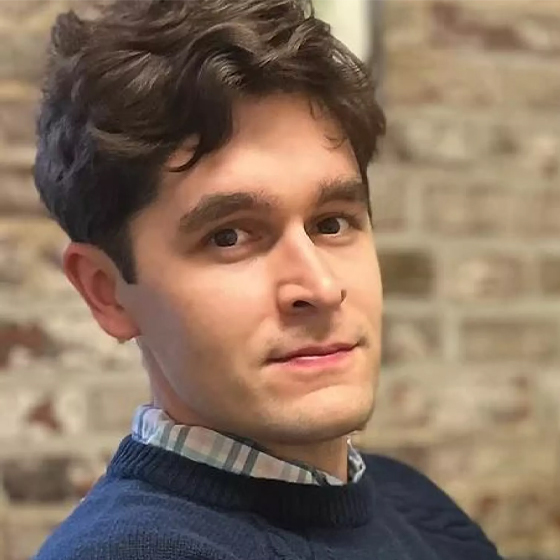
Campbell Conversation Spotlight
You probably know the name James Garfield, but how much else do you know about him, and why might he and his political times be relevant to considering today’s political landscape? Host Grant Reeher interviews C. W. Goodyear, a historian who has written a new definitive biography of him. His book is titled President Garfield: From Radical to Unifier.
December 9, 2023
Interested in partnering with us?
Doing Fieldwork: The Correspondence of Robert Redfield and Sol Tax, Revised Edition
Robert A. Rubinstein
Routledge, December 2001
Prior to the 1930s the highlands of Guatemala were largely undescribed, except in travelogues. Just two decades later, the highlands had become one of the most anthropologically well-investigated areas of the world. This is largely due to the research that Robert Redfield and Sol Tax carried out between 1934 and 1941.
Separately and together, Redfield and Tax anticipated and guided anthropological investigations of people living in peasant and urban communities in other areas of the world. Their work helped to define the major outlines of research in the 1970s, and since then much writing about the region has been formulated in critical response to the Redfield-Tax program. Not coincidentally, since the mid-1970s anthropology has been caught up in a wave of self-doubt about the status of fieldwork and the authority of ethnographic description. This critical stance has often cast ethnography as a creative, literary enterprise.
This volume presents a timely view of the process of ethnography as carried out by two of its early practitioners. Containing a wealth of ethnographic detail, the book reveals how Redfield and Tax developed and tested ethnological hypotheses, and it allows us to follow the development of their major theoretical statements. The result is an exceptionally clear picture of the process of ethnography. Redfield and Tax emerge as rigorous and sensitive observers of social life whose observations bear importantly on contemporary understandings of the ethnology of Guatemala and the enterprise of anthropology. This book will be of interest to students of method and theory in ethnography, Latin Americanists, and other professionals interested in the history of idea.