How News Coverage of Misinformation Shapes Perceptions and Trust
Emily Thorson
Cambridge University Press, May 2024
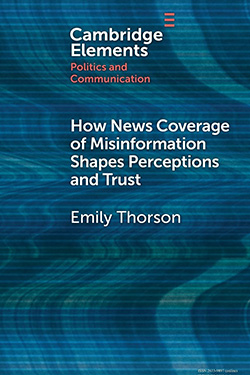
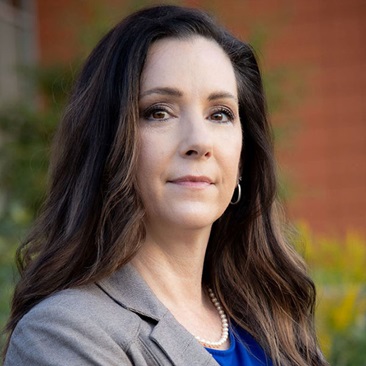
Emily Thorson, associate professor of political science, has published How News Coverage of Misinformation Shapes Perceptions and Trust (Cambridge University Press, 2024).
The book analyzes how the media addresses the issue of misinformation and how such coverage shapes public perception and trust. It explores the relationship between news and social media, highlighting how mainstream media often places blame on social media for the spread of false information. Through a combination of content analysis and experimental research, Thorson reveals that exposure to news about misinformation can erode trust in social media while enhancing trust in traditional print journalism. Ultimately, the book offers a deep and nuanced examination of how Americans perceive and trust the media.
Thorson is a senior research associate for the Campbell Public Affairs Institute. Her research focuses on American politics, misinformation and misperceptions, political psychology, and the media. Her honors include the Daniel Patrick Moynihan Award for Teaching and Research from Maxwell in 2024. Other published works include two articles on misinformation in Nature.
Thorson received a Ph.D. in communications and political science from the University of Pennsylvania in 2013.
From the publisher:
This Element takes on two related questions: How do the media cover the issue of misinformation, and how does exposure to this coverage affect public perceptions, including trust? A content analysis shows that most media coverage explicitly blames social media for the problem, and two experiments find that while exposure to news coverage of misinformation makes people less trusting of news on social media, it increases trust in print news. This counterintuitive effect occurs because exposure to news about misinformation increases the perceived value of traditional journalistic norms. Finally, exposure to misinformation coverage has no measurable effect on political trust or internal efficacy, and political interest is a strong predictor of interest in news coverage of misinformation across partisan lines. These results suggest that many Americans see legacy media as a bulwark against changes that threaten to distort the information environment.
Published in the Fall 2025 issue of the Maxwell Perspective
Related News
School News

Oct 7, 2026
Research

Oct 6, 2026
Media Coverage

Oct 6, 2026