Belief, Behavior, and Health: Religion as a Social Determinant of Health
Sandra D. Lane
Routledge, October 2024
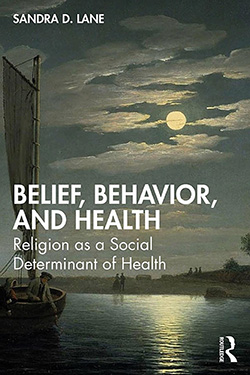
Sandra D. Lane, professor emerita of public health, has written Belief, Behavior, and Health: Religion as a Social Determinant of Health (Routledge, 2025).
The book details how religious beliefs across cultures impact health outcomes. It draws from research from the United States as well as Africa and the Middle East. Throughout, her book focuses on health inequalities among women and vulnerable populations.
Lane studies how religious beliefs, practices and discrimination significantly influence health within Judaism, Christianity and Islam.
Lane is also author of Why Are Our Babies Dying? Pregnancy, Birth, and Death in America (Paradigm Publishers, 2008). Recently, she co-authored “Addressing the Triple Trauma of Factors Leading to Perinatal Health and Mental Health Consequences in Two Upstate New York Communities,” an article published in the National Library of Medicine.
Lane is a senior research associate in the Campbell Public Affairs Institute and the Middle Eastern Studies Program. She is also a research professor of obstetrics and gynecology at Upstate Medical University. She is recognized as a Laura J. and L. Douglas Meredith Professor for Teaching Excellence.
From the publisher:
“This book uniquely examines, across cultures, the health benefits and detriments of religious beliefs, with important implications for individual wellbeing and human survival.
Belief, Behavior, and Health takes the reader through journeys of the author’s research in the Middle East, Africa, and the urban United States, where she focused on the unequal health and survival of women globally and vulnerable groups in the United States. Almost every health problem, especially those experienced by the poor and disadvantaged, arose from or was made worse by the conditions in the environment in which people lived. Lane’s detailed studies of beliefs about Judaism, Christianity, and Islam led to the author’s deep observations on how religious belief and practice, as well as discrimination due to religious prejudice, can be a major influence on health, both positively and negatively. In this book, Lane shows how religious precepts and cultural influences on religious behavior function as social determinants of health.
An accessible and compelling read, this book will appeal to students and scholars of public health, anthropology, and sociology and those interested in the influence of religion on health outcomes.”
Published in the Fall 2025 issue of the Maxwell Perspective
Related News
Media Coverage

Aug 24, 2026
Media Coverage

Aug 21, 2026
Media Coverage

Aug 20, 2026