Food for Thought: Understanding Older Adult Food Insecurity
Colleen Heflin, Madonna Harrington Meyer
Russell Sage Foundation, July 2025
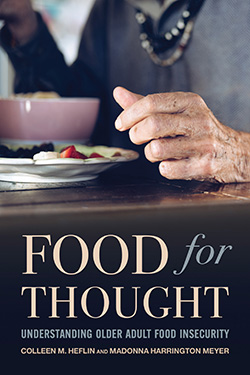
Colleen Heflin, professor of public administration and international affairs, and Madonna Harrington Meyer, University Professor, have published their co-written book Food for Thought: Understanding Older Adult Food Insecurity (Russell Sage Foundation, 2025).
The book examines the issue of food insecurity among older adults in the United States. By analyzing long-term risk, the authors show that 22% of older adults experience food insecurity in their 60s and 70s, challenging the assumption that the problem is limited to a small group. Food for Thought seeks to answer why food insecurity appears to decline with age and why older adults participate less in the Supplemental Nutrition Assistance Program (SNAP), exploring data and real-life stories to call for improved public policies that better address the needs of aging Americans.
Heflin is regarded as a national expert on food insecurity, nutrition and welfare policy. She specializes in social policy, poverty policy, and child and family policy and has published over 70 research articles. Her work has been supported with numerous grants, including a five-year award from the U.S. Department of Health and Human Services and a recent project supported by The Rockefeller Foundation that provides medically tailored grocery delivery to 250 Syracuse-based veterans. Called Food Is Medicine, the latter was also supported by the New York Health Foundation and Instacart.
Harrington Meyer’s research has also been funded by external organizations. She is a member of the sociology faculty and is a Laura J. and L. Douglas Meredith Professor of Teaching Excellence, specializing in social policy, aging and family policies. Her recognition has included the American Sociological Association’s Matilda White Riley Distinguished Scholar Award. She authored Grandmothers at Work: Juggling Families and Jobs (NYU Press, 2014), and co-authored Market Friendly or Family Friendly? The State and Gender Inequality in Old Age (Russell Sage Foundation, 2007), both of which won the Gerontological Society of America’s Kalish Book Award.
Heflin and Harrington Meyer are senior research associates for the Center for Policy Research and faculty affiliates for the Aging Studies Institute. They are also research affiliates for the Lerner Center for Public Health Promotion and Population Health and the Center for Aging and Policy Studies.
From the publisher:
The U.S. Department of Agriculture measures food insecurity by focusing on whether households have enough money to purchase food during the last twelve months. Among households containing adults sixty and older in 2023, 9.2 percent were classified as food insecure, and this proportion rises to 29.7 percent when the focus is on adults ages sixty and older living below the federal poverty line. When the authors consider the risk of food insecurity over a longer time frame than twelve months, 22 percent of older adults experienced food insecurity at some point in their sixties and seventies. This means that the cumulative risk of food insecurity is quite high across older ages. Food insecurity is not concentrated within a small subset of the population. Instead, a significant portion of older adults currently face economic constraints in their ability to afford food.
This book starts with two basic questions: Why does the measured risk of food insecurity go down in older age, and why are levels of participation in the Supplemental Nutrition Assistance Program so much lower for older adults than they are for prime-aged households? The answers to these two basic questions, and the others that they lead to, are critical to understand if we want to ensure that our public policies and programs support the needs of older adults. Motivated by their own desire to dig into the data and lived experience of older adults, the authors aim to create a better understanding of the issues around food insecurity for older adults with the goal of influencing public policy.
Related News
Research

Oct 8, 2026
Research

Oct 6, 2026
Media Coverage
Oct 6, 2026