Prepare to lead and make a difference in communities around the globe. At Maxwell, you’ll find faculty, students and alumni who are dedicated to the idea that well-trained public service-minded professionals can change the world.
Whether you are just starting out in your career or you are a seasoned professional, you’ll find a Maxwell program designed to help you:
- fill gaps in knowledge,
- build skills and confidence to take on a leadership role in your organization,
- prepare to move across sectors and,
- boost your ability to drive change.
Our Approach
We’ve situated a world-class team of public administration faculty among an equally accomplished faculty of the social sciences. This dynamic mix of educators and scholars creates a one-of-a-kind experience in which students immerse in interdisciplinary coursework and topical research at one of 14 research centers within the school.
You’ll reach your professional ambitions—fast. Our professional degrees provide exceptional preparation to advance your career in as few as 12 months, letting you get back to work more quickly than most other programs. And, if you have seven years of experience, you may qualify for one of our midcareer executive programs—with course options that are even more flexible and efficient.

Follow this link to learn more.

complete master’s degree options in as few as 12 months

award-winning faculty of national and international renown

global professional network 37,000 strong
Explore Master’s Degrees
Public Administration
Master of Public Administration
Prepare to lead positive change through a rigorous yet efficient array of skills-building courses.
- On campus, in Syracuse, N.Y.
- 40 credits plus optional internships
- Complete full-time in 12 to 18 months
Executive Master of Public Administration—On Campus or Online
Fill gaps in your knowledge with a program tailored to your career goals—five to seven years of experience required. An online option for working professionals provides added flexibility.
- Online or on campus in Syracuse, N.Y., options (separate programs)
- 30 credits
- Complete part- or full-time in as few as 12 to 15 months
International Relations
Master of Arts in International Relations
Satisfy your curiosity about the world, and develop skills and knowledge to change it for the better.
- On campus, in Syracuse, N.Y.
- 40 credits with a required global internship
- Required career track selection to focus your studies
- Complete full-time in 18 months
Master of Arts in Public Diplomacy and Global Communications
Prepare to drive change in a range of international contexts through effective public and interpersonal communications. One powerful degree, two schools: the Maxwell School and the S.I. Newhouse School of Public Communications.
- On campus, in Syracuse, N.Y., and Washington, D.C.
- 43 credits with a required global internship
- Complete full-time in 18 months
Executive Master's in International Relations
Improve your leadership and management skills and global affairs knowledge—seven years of experience required.
- On campus, in Syracuse, N.Y.
- 30 credits
- Complete on a part- or full-time basis
Doctoral Program
PhD in Public Administration
Educate the next generation of public service leaders and conduct research that moves the field of public administration and policy analysis forward.
- On campus, in Syracuse, N.Y.
- 72 credits (36 credits beyond the M.A.)
- Full-time residential program, typically completed in 4.5 years
Department Admission Events
We offer a range of in-person and virtual opportunities to learn more about the Maxwell School and degree programs offered by the Public Administration and International Affairs Department, answer questions about the application process, and help you work toward your goals.
See All Department Admission EventsSchedule a One-on-One Meeting
to ask more in-depth questions not covered in the group information sessions. These individual meetings are informational in nature and are not admission interviews.
Request a MeetingStudy in Washington, D.C.
Our D.C. headquarters at the Syracuse University Center in DuPont Circle, gives students access to leading minds in the world of policy and international affairs, competitive internships, employment opportunities and a deeply engaged network of D.C.-based alumni.
Need a midcareer boost? Explore our Certificates of Advanced Study
We offer a variety of regional, topical and skills-based Certificates of Advanced Study (CAS) to help you focus and refine your expertise. Some CAS can be earned as part of a master's program while others can be earned independent of a degree. Learn to use data to formulate and analyze policy, deepen your knowledge of effective public management practices, develop techniques to promote collaboration and resolve conflicts, broaden your expertise in a specific region of the world, and more.
Delta Democracy: Pathways to Incremental Civic Revolution in Egypt and Beyond
Catherine E. Herrold
Oxford University Press, March 2020
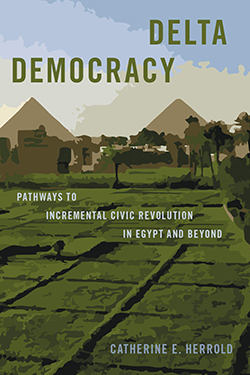
The 2011 Arab Spring protests seemed to mark a turning point in Middle East politics, away from authoritarianism and toward democracy. Within a few years, however, most observers saw the protests as a failure given the outbreak of civil wars and re-emergence of authoritarian strongmen in countries like Egypt. But in "Delta Democracy," Catherine E. Herrold argues that we should not overlook the ongoing mobilization taking place in grassroots civil society.
Drawing upon ethnographic research on Egypt's nongovernmental organizations (NGOs) in the wake of the uprisings, Herrold uncovers the strategies that local NGOs used to build a more democratic and just society. Departing from U.S.-based democracy advocates' attempts to reform national political institutions, local Egyptian organizations worked with communities to build a culture of democracy through public discussion, debate, and collective action. At present, these forms of participatory democracy are more attainable than establishing fair elections or parliaments, and they are helping Egyptians regain a sense of freedom that they have been denied as the long-time subjects of a dictator.
"Delta Democracy" advances our understanding of how civil society organizations maneuver under state repression in order to combat authoritarianism. It also offers a concrete set of recommendations on how US policymakers can restructure foreign aid to better help local community organizations fighting to expand democracy.
Related News
Media Coverage
May 20, 2026
Research
May 15, 2026
Media Coverage

May 11, 2026