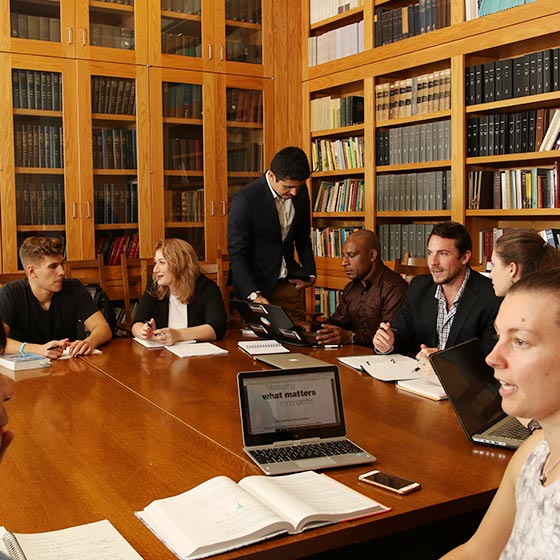
Prepare to lead and make a difference in communities around the globe. At Maxwell, you’ll find faculty, students and alumni who are dedicated to the idea that well-trained public service-minded professionals can change the world.
Whether you are just starting out in your career or you are a seasoned professional, you’ll find a Maxwell program designed to help you:
- fill gaps in knowledge,
- build skills and confidence to take on a leadership role in your organization,
- prepare to move across sectors and,
- boost your ability to drive change.
Our Approach
We’ve situated a world-class team of public administration faculty among an equally accomplished faculty of the social sciences. This dynamic mix of educators and scholars creates a one-of-a-kind experience in which students immerse in interdisciplinary coursework and topical research at one of 14 research centers within the school.
You’ll reach your professional ambitions—fast. Our professional degrees provide exceptional preparation to advance your career in as few as 12 months, letting you get back to work more quickly than most other programs. And, if you have seven years of experience, you may qualify for one of our midcareer executive programs—with course options that are even more flexible and efficient.

Follow this link to learn more.

complete master’s degree options in as few as 12 months

award-winning faculty of national and international renown

global professional network 37,000 strong
Explore Master’s Degrees
Public Administration
Master of Public Administration
Prepare to lead positive change through a rigorous yet efficient array of skills-building courses.
- On campus, in Syracuse, N.Y.
- 40 credits plus optional internships
- Complete full-time in 12 to 18 months
Executive Master of Public Administration—On Campus or Online
Fill gaps in your knowledge with a program tailored to your career goals—five to seven years of experience required. An online option for working professionals provides added flexibility.
- Online or on campus in Syracuse, N.Y., options (separate programs)
- 30 credits
- Complete part- or full-time in as few as 12 to 15 months
International Relations
Master of Arts in International Relations
Satisfy your curiosity about the world, and develop skills and knowledge to change it for the better.
- On campus, in Syracuse, N.Y.
- 40 credits with a required global internship
- Required career track selection to focus your studies
- Complete full-time in 18 months
Master of Arts in Public Diplomacy and Global Communications
Prepare to drive change in a range of international contexts through effective public and interpersonal communications. One powerful degree, two schools: the Maxwell School and the S.I. Newhouse School of Public Communications.
- On campus, in Syracuse, N.Y., and Washington, D.C.
- 43 credits with a required global internship
- Complete full-time in 18 months
Executive Master's in International Relations
Improve your leadership and management skills and global affairs knowledge—seven years of experience required.
- On campus, in Syracuse, N.Y.
- 30 credits
- Complete on a part- or full-time basis
Doctoral Program
PhD in Public Administration
Educate the next generation of public service leaders and conduct research that moves the field of public administration and policy analysis forward.
- On campus, in Syracuse, N.Y.
- 72 credits (36 credits beyond the M.A.)
- Full-time residential program, typically completed in 4.5 years
Department Admission Events
We offer a range of in-person and virtual opportunities to learn more about the Maxwell School and degree programs offered by the Public Administration and International Affairs Department, answer questions about the application process, and help you work toward your goals.
See All Department Admission EventsSchedule a One-on-One Meeting
to ask more in-depth questions not covered in the group information sessions. These individual meetings are informational in nature and are not admission interviews.
Request a MeetingStudy in Washington, D.C.
Our D.C. headquarters at the Syracuse University Center in DuPont Circle, gives students access to leading minds in the world of policy and international affairs, competitive internships, employment opportunities and a deeply engaged network of D.C.-based alumni.
Need a midcareer boost? Explore our Certificates of Advanced Study
We offer a variety of regional, topical and skills-based Certificates of Advanced Study (CAS) to help you focus and refine your expertise. Some CAS can be earned as part of a master's program while others can be earned independent of a degree. Learn to use data to formulate and analyze policy, deepen your knowledge of effective public management practices, develop techniques to promote collaboration and resolve conflicts, broaden your expertise in a specific region of the world, and more.
Effect of a School-Based Water Intervention on Child Body Mass Index and Obesity
Amy Ellen Schwartz, Michele Leardo & Siddhartha Aneja
The Journal of the American Medical Association, February 2016
Importance: Decreasing the amount of caloric beverages consumed and simultaneously increasing water consumption is important to promoting child health and decreasing the prevalence of childhood obesity.
Objective: To estimate the impact of water jets (electrically cooled, large clear jugs with a push lever for fast dispensing) on standardized body mass index, overweight, and obesity in elementary school and middle school students. Milk purchases were explored as a potential mechanism for weight outcomes.
Design, Setting, and Participants: This quasi-experimental study used a school-level database of cafeteria equipment deliveries between the 2008-2009 and 2012-2013 and included a sample of 1227 New York, New York, public elementary schools and middle schools and the 1 065 562 students within those schools.
Intervention: Installation of water jets in schools.
Main Outcomes and Measures: Individual body mass index (BMI) was calculated for all students in the sample using annual student-level height and weight measurements collected as part of New York’s FITNESSGRAM initiative. Age- and sex-specific growth charts produced by the Centers for Disease Control and Prevention were used to categorize students as overweight and obese. The hypothesis that water jets would be associated with decreased standardized BMI, overweight, and obesity was tested using a difference-in-difference strategy, comparing outcomes for treated and nontreated students before and after the introduction of a water jet.
Results: This study included 1 065 562 students within New York City public elementary schools and middle schools. There was a significant effect of water jets on standardized BMI, such that the adoption of water jets was associated with a 0.025 (95% CI, −0.038 to −0.011) reduction of standardized BMI for boys and a 0.022 (95% CI, −0.035 to −0.008) reduction of standardized BMI for girls (P < .01). There was also a significant effect on being overweight. Water jets were associated with a 0.9 percentage point reduction (95% CI, 0.015-0.003) in the likelihood of being overweight for boys and a 0.6 percentage reduction (95% CI, 0.011-0.000) in the likelihood of being overweight for girls (P < .05). We also found a 12.3 decrease (95% CI, −19.371 to −5.204) in the number of all types of milk half-pints purchased per student per year (P < .01).
Conclusions and Relevance: Results from this study show an association between a relatively low-cost water availability intervention and decreased student weight. Milk purchases were explored as a potential mechanism. Additional research is needed to examine potential mechanisms for decreased student weight, including reduced milk taking, as well as assessing impacts on longer-term outcomes.
Related News
Research

Jun 3, 2025
Research
Sep 24, 2024
Media Coverage

Sep 3, 2024