Public Health: A Vital Addition to Maxwell
December 5, 2025
The department’s transition from Falk College fuels collaboration across disciplines, strengthens research centers, and establishes a hub for population and public health sciences.
When epidemiologist Brittany Kmush began studying the patterns and causes of COVID-19, she focused on human behavior and the development and distribution of vaccines. Political scientist Shana Kushner Gadarian, meanwhile, examined how the pandemic intersected with polarization, misinformation, and public trust in science and government.
Now the two scholars are collaborating on a new research project exploring how changing state and federal vaccine guidelines shape people’s decisions about whether to get vaccinated.
The partnership reflects a larger story taking shape at the Maxwell School: the integration of the Public Health Department into its interdisciplinary ecosystem.
“My hope is that our vaccine study helps fill an information gap for the public and policymakers,” says Kmush, associate professor and graduate director of public health. “And that it lays the groundwork for future collaboration with my new Maxwell colleagues.”
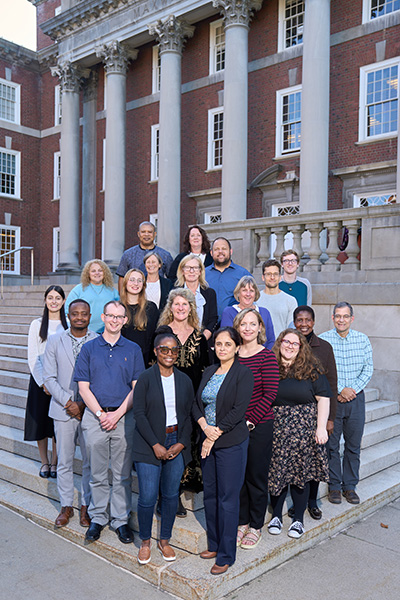
That spirit of collaboration was central to a Universitywide restructuring last summer that moved public health to Maxwell from the recently renamed and refocused Falk College of Sport. The shift brought 14 faculty, several staff members and research associates, more than 150 students and thousands of alumni into the Maxwell community. The school is now home to Syracuse’s bachelor of science in public health and master of public health (MPH) degree programs, along with minors in public health and healthcare management and a certificate of advanced study in addiction studies.
“Public health’s faculty expertise in areas like global and environmental health, infectious disease, and health policy strengthens Maxwell’s voice in addressing today’s most pressing challenges,” says Dean David M. Van Slyke, noting the addition aligns with Maxwell’s academic strategic plan that emphasizes health and health disparities as a major focus area.
Kmush initiated the vaccine study this past spring, after she learned of public health’s pending move to Maxwell where Gadarian is a professor of political science and associate dean for research. She applied for and received a Maxwell-based grant, funded by advisory board member David Kelso ’68, to support their work.
“When I learned public health was joining Maxwell, I was excited about the opportunity to collaborate more closely with Shana and others who look at similar issues through different lenses,” says Kmush.
A Hub for Health Sciences and Policy
The collaborative energy was on display in early November when dozens of faculty and graduate students gathered in Lyman Hall for the Maxwell Population Health Research Symposium. Organized by Shannon Monnat, professor of sociology and Lerner Chair in Public Health Promotion and Population Health, the event was designed to connect scholars across disciplines whose research touches health issues—and to welcome the Public Health Department to the school.
“Adding public health into the fold deepens our collective capacity to address pressing population health challenges through policy-relevant research. Their work aligns with Maxwell’s long-standing commitment to understanding how policies shape the well-being of individuals and communities,” says Monnat.
The symposium was co-sponsored by the Center for Policy Research (CPR), which Monnat directs, and three other Maxwell-based centers and institutes: the Lerner Center for Public Health Promotion and Population Health, the Aging Studies Institute, and the Center for Aging and Policy Studies.
Lerner Center Director Rebekah Lewis was excited by the engagement and enthusiasm of symposium attendees who represented a wide range of Maxwell disciplines. “Many public health faculty have had long-standing affiliations with the Lerner Center and we look forward to increased collaboration and the expansion of public health expertise,” she says.
Among the symposium participants was John Cawley, the Daniel Patrick Moynihan Chair in Public Policy and a senior research associate in CPR. He joined Maxwell shortly after public health’s transition and researches the economics of risky health behaviors such as poor diet, inactivity and obesity (see related story).
In a seven-minute “flash talk,” Cawley provided attendees a glimpse of his work on the influence of “early life health endowments”—factors such as a genetic predisposition to a higher body mass index—on later life outcomes, like the probability of graduating high school or getting a college degree.
University Professor Jennifer Karas Montez, who moderated the flash talks, underscored what was apparent throughout the day: the addition of public health strengthens Maxwell’s 15 research centers and institutes.
“Bringing population and public health together in one school is a smart move,” says Montez. “It solidifies Maxwell as an interdisciplinary hub for health sciences and policy.”
Good Synergy
As Rebekah Lewis notes, collaboration with public health faculty began well before the merger. In Lerner, for instance, several public health scholars have contributed research briefs in recent years.

David Larsen, professor and chair of public health, had worked with Peng Gao, professor and chair of geography and the environment, on studies using mapping to understand health trends and inform policy. On one recent project, co-authored with Robert A. Rubinstein, Distinguished Professor of Anthropology and professor of international relations, and Sandra D. Lane, professor emerita of public health, they examined the impact of the pandemic on gun violence in the City of Syracuse.
Using geospatial analysis, the researchers discovered that gun violence has remained concentrated in the same southwest neighborhoods for 15 years—suggesting pandemic policies did little to alter those long-term patterns. Their findings were published in the International Journal of Health Geographics.
Gao and Larsen recently began a new collaboration studying the health impact of air pollution from the I-81 viaduct construction project on nearby communities.
“Previously at Syracuse, the field of public health was largely split between our department in Falk College and our colleagues in Maxwell,” Larsen explains. “Bringing us all together under the Maxwell umbrella strengthens our program, leads to new research inquiry and collaboration, and ultimately benefits our students.”
Jonnell Robinson, associate professor of geography and the environment, is also building on the connection between geography and public health by creating a new undergraduate course, GIS for Public Health, that explores how mapping and spatial analysis can illuminate public health challenges.
“There’s a good synergy between geography and public health—both are place-based and intersectional,” says Robinson, who has a master of public health and Ph.D. in medical geography.
Other Maxwell departments are finding natural points of intersection with public health. In public administration and international affairs (PAIA), Colleen Heflin examines food insecurity and health disparities. She notes that the pandemic revealed how deeply public health touches every aspect of society and the economy. “As a nation, we learned firsthand how public health can impact older adult mental health, change access to education, shape the economic structure and connect to politics,” she says.
Heflin’s PAIA faculty colleagues The Hon. James E. Baker and Vice Admiral (U.S. Navy, retired) Robert Murrett, are academic partners in the US-Ukraine Veterans Bridge, which supports Ukraine’s burgeoning veteran population. Their work complements that of Professor of Public Health Dessa Bergen-Cico, who last summer trained a group of Ukrainian psychologists in the use of a mindfulness-based intervention that she co-developed with psychologists at the Syracuse Veterans Administration.
In sociology, meanwhile, faculty and graduate students are exploring issues related to aging, family, education and community well-being—all tied to health equity and access. Professor Scott Landes studies the sociology of disability, which intersects with work by Katherine McDonald, professor of public health.
Sociology Ph.D. student Anna De La Paz expects the addition of public health to enhance her focus on breastfeeding practices, maternal and child health, and public health policy.
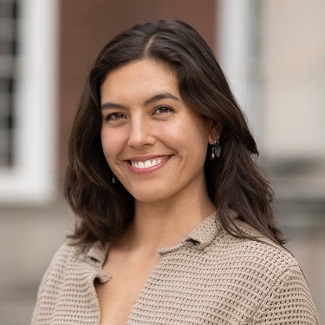
“For graduate students, I think the integration of public health into Maxwell really strengthens the bridge between social science theory and applied health policy,” say De La Paz, a registered dietician and doula who completed her undergraduate degree at Falk College. “I am hopeful this department addition creates new opportunities to translate research into meaningful policy solutions.”
Wide Reach, Shared Purpose
The addition of public health expands Maxwell’s impact far beyond Syracuse University. This past summer, Dessa Bergen-Cico partnered with Maxwell’s Executive Education Program for an initiative that brought 20 leaders from around the world to campus for the Distinguished Humphrey Fellowship Program on Combatting Illicit Drug Trafficking. Funded by the Bureau of Educational and Cultural Affairs at the U.S. Department of State, it was part of the federal government’s wider global efforts to combat illicit drugs.
“It aligned with the Maxwell School’s efforts to foster global engagement and informed dialogue around complex international issues,” says Bergen-Cico, who invited Maxwell social scientists, including Associate Dean and Professor of History Gladys McCormick, to offer expertise to the visiting scholars.
Back at the Maxwell Population Health Research Symposium, the vast impact was on full display. During the flash talk presentations, faculty shared how they and students are contributing to research and policy conversations on everything from addiction and trauma to health communication and global disease prevention. Among them was Michiko Ueda-Ballmer, who shared her work on the topic of suicide and self-help outreach.
Ueda-Ballmer, associate professor of public administration and international affairs, pointed to a recent study with Colleen Heflin that found that targeted outreach and accurate information could promote greater utilization of a relatively new 24-hour crisis hotline, 988.
Dean David M. Van Slyke says the breadth reflects Maxwell’s founding mission—linking citizenship, policy and the public good.
“Maxwell has always been about addressing complex social challenges,” says Van Slyke. “Public health brings another vital dimension to that work—one that directly affects people’s lives and communities.”
Includes reporting by Cort Ruddy
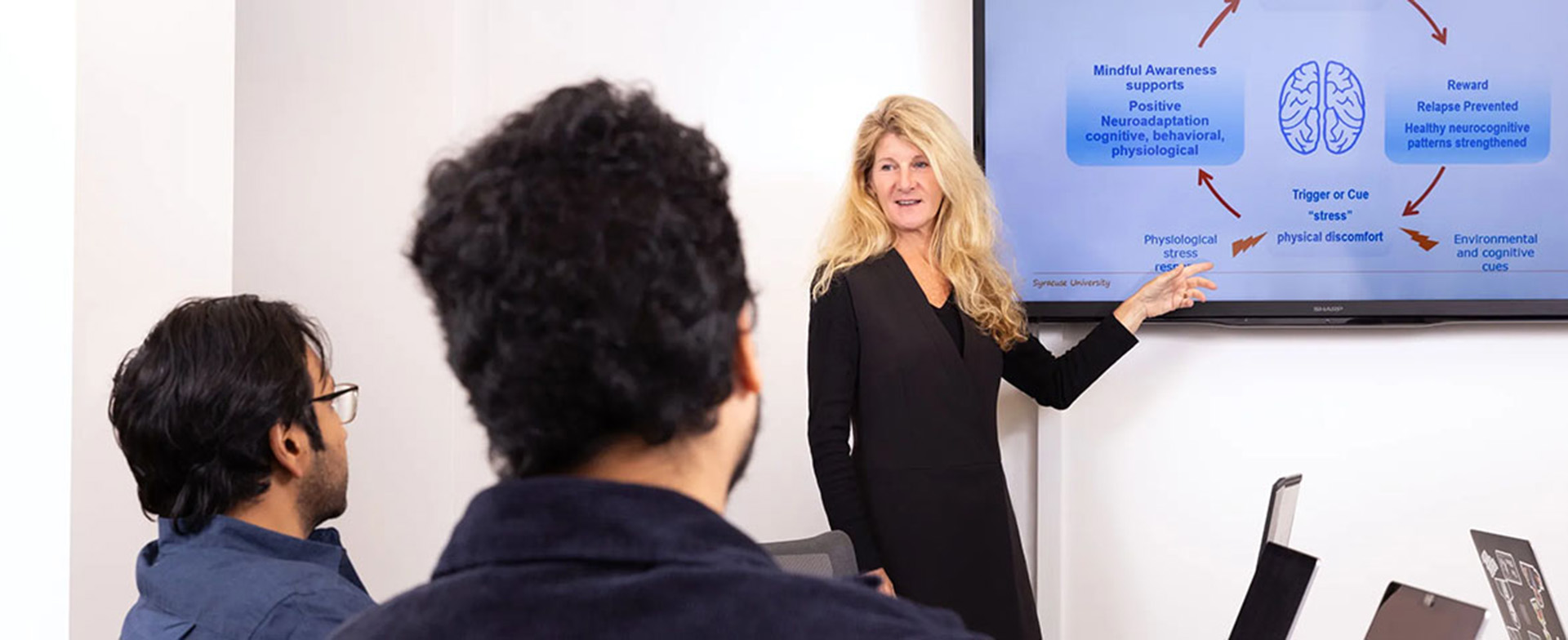
PHOTO ABOVE: Dessa Bergen-Cico is among the public health faculty who joined Maxwell. Her research interests include substance use, addictive behaviors, drug trafficking, veterans’ mental health and mindfulness interventions.
Published in the Fall 2025 issue of the Maxwell Perspective
PUBLIC HEALTH BY THE NUMBERS
125: Undergraduates
27: Graduate students
1,200: Alumni
21: Countries in which alumni live and work
43: U.S. states and territories in which alumni reside
Related News
School News
Oct 6, 2026
School News
Oct 5, 2026
School News
Oct 1, 2026
School News
Sep 24, 2026