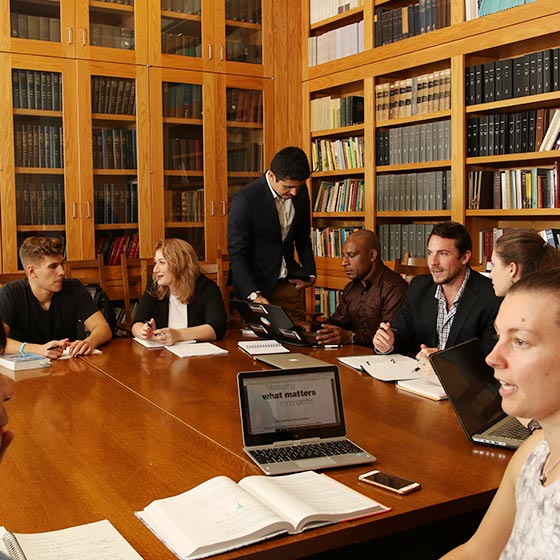
Prepare to lead and make a difference in communities around the globe. At Maxwell, you’ll find faculty, students and alumni who are dedicated to the idea that well-trained public service-minded professionals can change the world.
Whether you are just starting out in your career or you are a seasoned professional, you’ll find a Maxwell program designed to help you:
- fill gaps in knowledge,
- build skills and confidence to take on a leadership role in your organization,
- prepare to move across sectors and,
- boost your ability to drive change.
Our Approach
We’ve situated a world-class team of public administration faculty among an equally accomplished faculty of the social sciences. This dynamic mix of educators and scholars creates a one-of-a-kind experience in which students immerse in interdisciplinary coursework and topical research at one of 14 research centers within the school.
You’ll reach your professional ambitions—fast. Our professional degrees provide exceptional preparation to advance your career in as few as 12 months, letting you get back to work more quickly than most other programs. And, if you have seven years of experience, you may qualify for one of our midcareer executive programs—with course options that are even more flexible and efficient.

Follow this link to learn more.

complete master’s degree options in as few as 12 months

award-winning faculty of national and international renown

global professional network 37,000 strong
Explore Master’s Degrees
Public Administration
Master of Public Administration
Prepare to lead positive change through a rigorous yet efficient array of skills-building courses.
- On campus, in Syracuse, N.Y.
- 40 credits plus optional internships
- Complete full-time in 12 to 18 months
Executive Master of Public Administration—On Campus or Online
Fill gaps in your knowledge with a program tailored to your career goals—five to seven years of experience required. An online option for working professionals provides added flexibility.
- Online or on campus in Syracuse, N.Y., options (separate programs)
- 30 credits
- Complete part- or full-time in as few as 12 to 15 months
International Relations
Master of Arts in International Relations
Satisfy your curiosity about the world, and develop skills and knowledge to change it for the better.
- On campus, in Syracuse, N.Y.
- 40 credits with a required global internship
- Required career track selection to focus your studies
- Complete full-time in 18 months
Master of Arts in Public Diplomacy and Global Communications
Prepare to drive change in a range of international contexts through effective public and interpersonal communications. One powerful degree, two schools: the Maxwell School and the S.I. Newhouse School of Public Communications.
- On campus, in Syracuse, N.Y., and Washington, D.C.
- 43 credits with a required global internship
- Complete full-time in 18 months
Executive Master's in International Relations
Improve your leadership and management skills and global affairs knowledge—seven years of experience required.
- On campus, in Syracuse, N.Y.
- 30 credits
- Complete on a part- or full-time basis
Doctoral Program
PhD in Public Administration
Educate the next generation of public service leaders and conduct research that moves the field of public administration and policy analysis forward.
- On campus, in Syracuse, N.Y.
- 72 credits (36 credits beyond the M.A.)
- Full-time residential program, typically completed in 4.5 years
Department Admission Events
We offer a range of in-person and virtual opportunities to learn more about the Maxwell School and degree programs offered by the Public Administration and International Affairs Department, answer questions about the application process, and help you work toward your goals.
See All Department Admission EventsSchedule a One-on-One Meeting
to ask more in-depth questions not covered in the group information sessions. These individual meetings are informational in nature and are not admission interviews.
Request a MeetingStudy in Washington, D.C.
Our D.C. headquarters at the Syracuse University Center in DuPont Circle, gives students access to leading minds in the world of policy and international affairs, competitive internships, employment opportunities and a deeply engaged network of D.C.-based alumni.
Need a midcareer boost? Explore our Certificates of Advanced Study
We offer a variety of regional, topical and skills-based Certificates of Advanced Study (CAS) to help you focus and refine your expertise. Some CAS can be earned as part of a master's program while others can be earned independent of a degree. Learn to use data to formulate and analyze policy, deepen your knowledge of effective public management practices, develop techniques to promote collaboration and resolve conflicts, broaden your expertise in a specific region of the world, and more.
The Social and Community Consequences of the Opioid Epidemic
Rajeev Darolia, Colleen Heflin
The ANNALS of the American Academy of Political and Social Science, March 2023
Related:
We provide a brief orientation to the articles that comprise this volume, which is an effort to understand the consequences of the opioid epidemic in a variety of societal and community domains.
These domains include child welfare, living arrangements, education, food insecurity, housing, and public budgets, and they are often paid scant attention compared to research that focuses on the direct effects of opioid use.
We give an overview of the articles that comprise this volume and discuss the ways in which they contribute new empirical insights on the consequences of the opioid crisis in the U.S. and Canada.
We conclude with thoughts on the challenges inherent in this work, insights about how this volume of research might help us understand the broader reach of the epidemic, and how it helps in the development of prosocial public policies.
Colleen Heflin, professor and chair of public administration and international affairs, also wrote a blog post about the study, "Social and Community Consequences of the Opioid Epidemic."
Related News
Media Coverage

May 22, 2026
School News

May 22, 2026
Research
May 21, 2026